
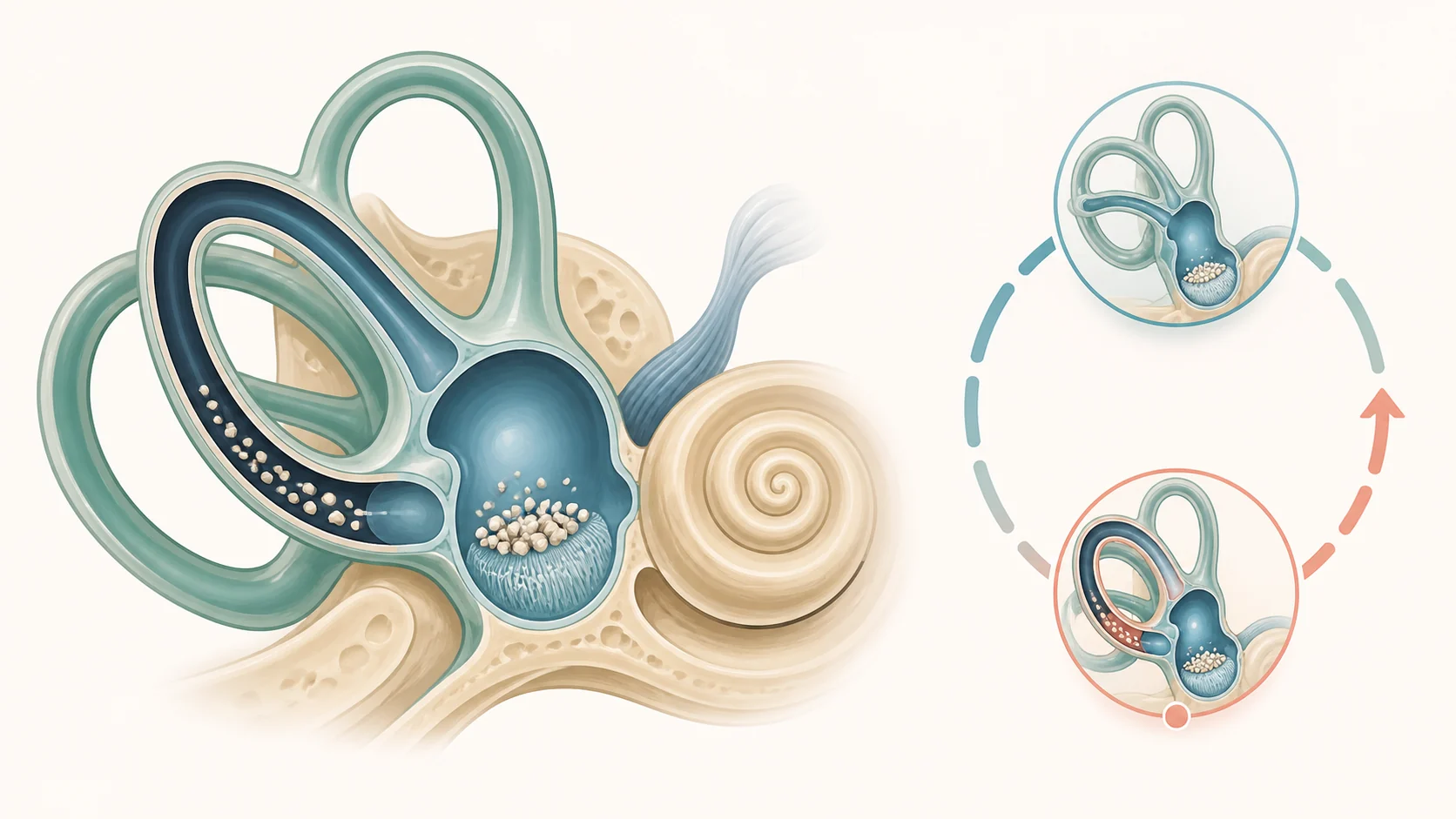
Quick answer: BPPV recurrence means that a compatible positional-vertigo episode returns after symptoms had settled. It can happen, but a previous diagnosis does not prove that every new dizzy spell is BPPV or show which ear and canal are involved now. The safest next step is to compare the new pattern with the earlier episode and confirm the current positional findings before repeating a manoeuvre.
Seek urgent help for a different or dangerous pattern. Call local emergency services or go to the nearest emergency department for new weakness or numbness, facial droop, speech difficulty, double vision, inability to stand or walk, fainting, chest pain, a sudden severe headache, confusion or another new neurological symptom. Do not try a home manoeuvre first and do not drive yourself. Sudden hearing loss in one ear needs same-day urgent medical or ENT assessment.
Table of Contents
What counts as BPPV recurrence?
Clinicians distinguish suspected recurrent BPPV from symptoms that never fully resolved. Recurrence usually means the earlier positional symptoms settled and a later episode again has the brief, position-triggered pattern and examination findings expected for BPPV. Studies use different symptom-free intervals, so there is no single online time rule that confirms recurrence.
When the spinning never stopped, the original side or canal may still be active, another canal may be involved, or the diagnosis may need review. When the spinning has stopped but non-spinning unsteadiness or motion sensitivity remains, the problem may be residual dizziness after repositioning rather than recurrent BPPV.
Recurrent BPPV, persistent BPPV and residual dizziness are different
- Suspected recurrence: a new compatible episode after a symptom-free period.
- Persistent or treatment-resistant BPPV: positional vertigo and the expected positional eye movements remain despite an appropriately selected manoeuvre.
- Residual dizziness: spinning and positional findings have settled, but a milder non-spinning “off” feeling, motion sensitivity or imbalance remains.
These states need different decisions. Repeating the same remembered sequence can be unhelpful when the current side, canal or diagnosis is different. A Dix–Hallpike examination is used for common posterior-canal patterns, while a supine roll test is considered for horizontal-canal BPPV. The observed nystagmus pattern—not simply which side feels worse—guides the choice.
Why can BPPV come back?
BPPV occurs when otoconia from the inner-ear balance organs enter a semicircular canal or affect its movement sensing. Repositioning aims to clear the involved canal; it does not guarantee that particles can never move again. A later recurrence is therefore possible even when the earlier episode was correctly diagnosed and treated.
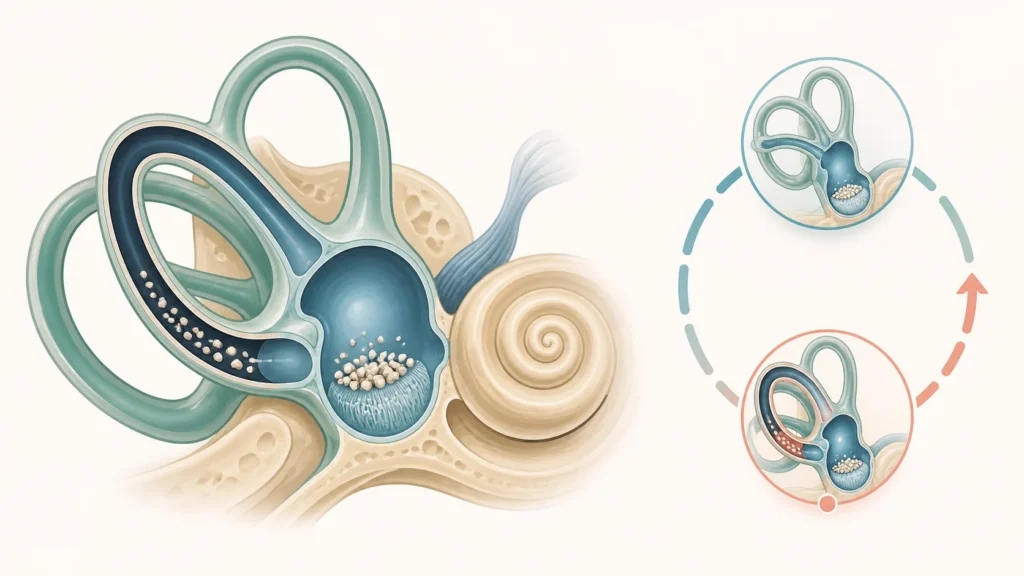
Research has reported associations between recurrent BPPV and factors such as previous episodes, migraine, head injury, inner-ear disease, bone or mineral health, diabetes and vitamin-D status. These are population-level associations. They do not prove one cause in an individual, and many people have no single identifiable trigger.
Published recurrence estimates vary because studies include different patients, define recurrence differently and follow people for different lengths of time. This page therefore does not provide one personal recurrence percentage or promise that a particular step will prevent every future attack.
What does the newer research add?
A 2026 retrospective referral-centre study examined repeated canalith-repositioning response rather than recurrence. Mechanical BPPV subtype was the strongest predictor of repeated procedure failure in that cohort, while the vitamin-D association differed by subtype. The authors also noted referral bias, a heterogeneous “atypical” group and the absence of one universally accepted manoeuvre-count threshold. The practical message is to recheck the observed pattern—not to label every patient “refractory” after an online session count.
A separate 2026 two-centre retrospective study developed a preliminary recurrence model using diabetes, non-posterior-canal involvement and low vitamin D. It performed well in its selected cohorts, but the external cohort was small, common coexisting dizziness conditions were excluded, and model-guided treatment has not been proven prospectively. It should not be used as a home calculator or as a reason to start treatment without assessment.
Vitamin D, bone health and recurrent BPPV
Vitamin-D status may be relevant in selected patients, particularly when BPPV is recurrent and deficiency or bone-health concerns are already plausible. However, low vitamin D is not a complete explanation for every recurrence, and observational associations do not prove that correcting one laboratory value will prevent all attacks.
Do not start high-dose vitamin D, change calcium intake or combine supplements solely because positional vertigo returned. Testing and treatment should consider the medical history, kidney and calcium-related conditions, bone health, current medicines and other individual factors. The manoeuvre for active BPPV still depends on the current side and canal.
What should you do when positional vertigo returns?
- Screen for a changed or urgent pattern. New neurological symptoms, sudden hearing loss, collapse, chest symptoms or unsafe walking do not belong in a routine home-manoeuvre pathway. See the established acute vertigo and stroke-warning guide; it is an education/reference page, not a home HINTS examination.
- Describe the current episode. Record the trigger, duration, symptom-free interval, hearing symptoms, headache, walking safety, faintness, medicines and whether the sensation differs from the earlier BPPV.
- Confirm the present side and canal. A current positional examination is more reliable than assuming the earlier side is still involved.
- Use a canal-specific plan. An Epley manoeuvre is intended for a suitable posterior-canal pattern; horizontal, anterior, multi-canal or atypical findings may need a different approach.
- Reassess when treatment does not fit the result. Persistent positional findings, repeated failures, a changed pattern or continuing imbalance should trigger diagnostic review rather than indefinite manoeuvre repetition.
For the general diagnosis and treatment pathway, use the BPPV patient guide.
Can BPPV recurrence be prevented?
There is no guaranteed prevention plan for every patient. A clinician may consider treatment of confirmed deficiency, review of bone health or relevant medical conditions, falls-risk reduction and follow-up when the episode pattern is recurrent or treatment-resistant. Those decisions should be matched to the person’s history rather than offered as a universal package.
No specific sleeping side, food, caffeine rule, indefinite vestibular exercise programme or repeated home manoeuvre can guarantee that BPPV will not return. Until walking is steady, avoid driving, two-wheelers, height work, ladders, swimming alone and other activities where a sudden attack could cause harm.
What information helps at reassessment?
- the date the earlier episode settled and the date the new one began;
- the exact position that triggers spinning and how long it lasts;
- whether hearing, tinnitus, ear pressure, headache, vision or walking changed;
- previous positional-test findings and which manoeuvre was performed;
- recent injury, illness, surgery, prolonged bed rest or medicine changes;
- vitamin-D, calcium or bone-health reports when already available;
- neck, back, vascular or mobility limitations that may affect testing.
Frequently asked questions
Why does BPPV keep coming back?
Otoconia can enter a semicircular canal again after an earlier episode settles. Research also reports several associated health and vestibular factors, but many patients have no single identifiable cause.
Does recurrent vertigo always mean recurrent BPPV?
No. Migraine, another inner-ear disorder, blood-pressure or faintness pathways, medicine effects and neurological causes can produce a different pattern. Hearing changes, continuous vertigo, unsafe walking or neurological symptoms need a different assessment route.
Should I repeat the Epley manoeuvre every time?
Not from dizziness alone. Epley is intended for an appropriate posterior-canal pattern and side. A changed, uncertain or persistent episode is safer to recheck before repeating a remembered sequence.
Should everyone with recurrent BPPV take vitamin D?
No. Testing and supplementation may be considered for selected patients, but the need, dose and monitoring depend on the clinical and laboratory context. Do not start high-dose vitamin D or calcium from a webpage.
References
- AAO-HNS Clinical Practice Guideline: Benign Paroxysmal Positional Vertigo (Update).
- Joo HA, et al. Risk factors for refractory BPPV: subtype-dependent association of serum 25-hydroxyvitamin D. Frontiers in Neurology. 2026.
- Jin Q, et al. Development and external validation of a LASSO-based parsimonious nomogram for predicting BPPV recurrence. Frontiers in Neurology. 2026.
- Identifying key risk factors for the recurrence of benign paroxysmal positional vertigo following successful canalith repositioning maneuvers: a meta analysis. 2025.
- NICE NG127: suspected neurological conditions—adult referral recommendations.
Medical Disclaimer: This article is for educational purposes only and does not constitute medical advice, diagnosis or prescribing guidance. Consult Dr. Prateek Porwal at Prime ENT Center, Hardoi for personalised treatment.
Read next — from Dr. Porwal's vertigo library