
Dix–Hallpike Test for BPPV: What the Result Means
Seek urgent medical help before considering a positional test
New facial weakness, arm or leg weakness, difficulty speaking, severe new headache, double vision, fainting, inability to stand or walk safely, persistent vomiting, chest pain or another sudden neurological symptom needs urgent medical assessment. Do not delay emergency care to try a positional test or manoeuvre. Do not drive yourself.
What is the Dix–Hallpike test?
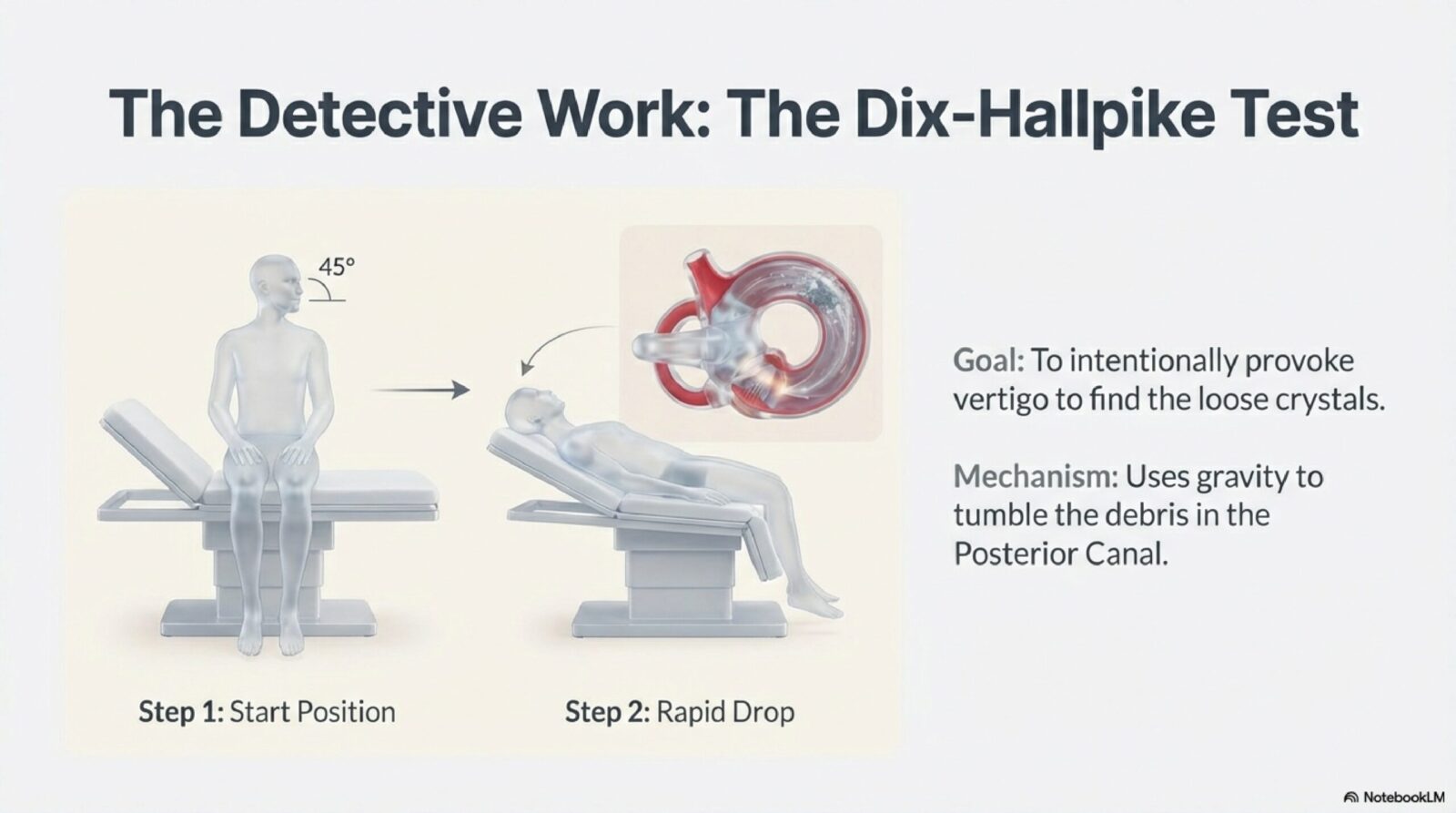
The Dix–Hallpike test is a clinical positional test used when a person’s history suggests posterior-canal benign paroxysmal positional vertigo, usually shortened to BPPV. BPPV often causes brief attacks of spinning after a change in head position, such as lying back, turning in bed or looking upward.
The test is not simply a way to make someone dizzy. A trained clinician looks at the history, the timing of symptoms and the eye movements produced during the test. The pattern and timing of those eye movements help the clinician decide whether posterior-canal BPPV is likely and which ear may be involved.
Who should perform it?
The test should be selected and performed by a clinician who can support the patient, observe the eyes and interpret the response. It should not be used at home to rule in BPPV or rule out a neurological cause of dizziness.
Tell the clinician before testing if you have significant neck or back problems, severe limitation of neck movement, recent neck or spine injury or surgery, known instability, serious vascular disease, marked frailty or another reason why rapid positioning may be unsafe. The clinician may modify the assessment, use another method or defer it after considering the risks.
What happens during the appointment?
The clinician first asks what triggers the attacks, how long they last and whether there are hearing, neurological or fainting symptoms. If the history is suitable and the movement is safe, the clinician supports you while moving the head and body into a test position. Your eyes and symptoms are observed for a short period. The clinician may test the other side or use a different positional test if the result is unclear.
This description is for understanding the appointment, not for copying the test without clinical support.
What can a positive result show?
A typical response combines positional vertigo with a characteristic pattern of involuntary eye movement. Dizziness without the expected eye movement does not automatically confirm posterior-canal BPPV. A clinician must interpret the whole response in context.
A result can also be inconclusive. Symptoms may have settled temporarily, another semicircular canal may be involved, or the problem may not be BPPV. Further history, examination or a different positional test may be appropriate.
What happens after a result consistent with BPPV?
The clinician may discuss an appropriate canal-repositioning manoeuvre after confirming the likely canal and side and checking whether the movement is safe. The choice is individual. Do not repeat a manoeuvre merely because it appears in a video or because a previous episode felt similar.
If symptoms persist, change character or include a new neurological, hearing or balance problem, seek reassessment rather than assuming that BPPV has returned.
Where recording and positioning technology may help
For a typical symptom history and a characteristic posterior-canal eye-movement response, bedside positional examination remains the first-line approach. Video recording can help a trained clinician document and review the nystagmus pattern when the response is subtle, atypical or difficult to interpret. It does not make the diagnosis by itself and it cannot rule out a neurological cause of dizziness.
A small 2026 study explored a model based on timing and eye-movement speed from video-recorded Dix–Hallpike tests. Its results are promising as clinician decision support, but the study included only 26 patients, used repeated observations from the same small cohort and had very limited independent testing. It should not be turned into an online diagnostic score or used to replace examination.
A separate crossover study in adults aged 60 years and older found that a mechanical rotation chair detected some BPPV patterns that bedside testing did not, particularly non-posterior patterns and cases where positioning or cooperation was difficult. Bedside testing still remained the first-line method. A chair is a specialist option for selected complex or inconclusive cases, not a requirement for every older patient with dizziness.
What sensor-guided manoeuvre research does—and does not—show
Wearable motion sensors are also being studied as a way to give positioning feedback during a canalith-repositioning procedure. Early comparative research suggests that audio-guided positioning is technically feasible, but the evidence remains preliminary and does not prove that unsupervised treatment is equivalent to specialist care. The study also found early return of findings in some initially improved participants, which reinforces the need for reassessment and follow-up.
Technology cannot decide the diagnosis, affected side, canal, neck or spine safety, fall risk or emergency pathway on its own. Do not use these studies as instructions to repeat positional tests or choose a manoeuvre at home. A clinician should first match the timing, triggers, hearing symptoms, neurological signs and observed eye movements.
New evidence reviewed for this update
- Jakobsen KM, et al. Predictive model for typical versus atypical BPPV recordings (2026).
- Hougaard DD, et al. Mechanical-chair versus bedside BPPV diagnostics in older adults (2026).
- Kwon C, et al. Wearable IMU-guided canalith repositioning feasibility study (2026).
Frequently asked questions
Does feeling dizzy during the test prove BPPV?
No. The clinician considers the eye movement, timing, symptom pattern and other examination findings. Dizziness by itself is not a complete diagnosis.
Can I perform the Dix–Hallpike test myself?
It should not be used as a home diagnostic test. A clinician needs to assess whether the positioning is safe, support you, observe the eyes and interpret the response.
What if the test is negative?
A negative or unclear result does not explain every cause of positional dizziness. The clinician may review the history, repeat or modify the assessment, consider another canal or investigate another cause.
Is it the right test for every kind of dizziness?
No. It is intended for a particular pattern of brief positional vertigo. Continuous dizziness, fainting, new neurological symptoms or other atypical features require a different assessment.
References
- Bhattacharyya N, et al. Clinical Practice Guideline: Benign Paroxysmal Positional Vertigo (Update). Otolaryngology–Head and Neck Surgery. 2017;156:S1–S47. Source
- Humphriss RL, et al. Contraindications to the Dix-Hallpike manoeuvre: a multidisciplinary review. International Journal of Audiology. 2003;42:166–173. Source
Medical note: This article explains a clinician-performed test and is not a diagnosis or a home-testing guide.