
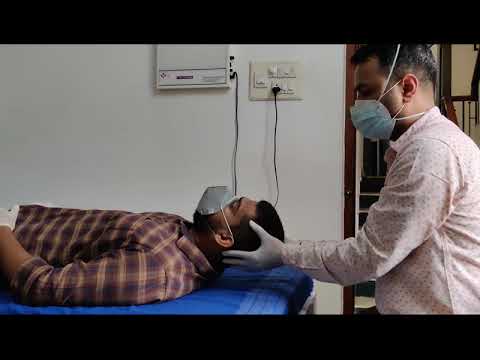
Quick answer: The supine roll test, also called the McClure–Pagnini or supine head roll test, helps a clinician identify horizontal-canal BPPV. The direction and relative intensity of the observed horizontal nystagmus must be interpreted as a complete pattern; dizziness alone cannot identify the canal or affected side.
Seek urgent help for warning symptoms
Sudden weakness, difficulty speaking, double vision, severe new headache, fainting, inability to stand or walk safely, persistent vomiting, chest pain or another sudden neurological symptom needs urgent medical assessment. Do not try a positional test or manoeuvre first. Do not drive yourself.
What is the supine roll test?
The supine roll test is a clinical positional test used when the history and examination suggest horizontal-canal BPPV. Horizontal-canal BPPV can cause brief spinning when a person rolls in bed or turns the head while lying down.
It is also called the supine head roll test, head roll test or McClure–Pagnini test. The clinician observes involuntary eye movements while the head and body are positioned in a controlled way. The direction, strength, duration and symmetry of the response are interpreted together with the patient’s symptoms and history.
When is it used instead of the Dix–Hallpike test?
The tests answer different questions. The Dix–Hallpike test is mainly used for posterior-canal BPPV. Clinical guidance recommends a supine roll test when the history is compatible with BPPV but Dix–Hallpike testing shows horizontal eye movements or no nystagmus. The roll test is not a general screening test for every cause of dizziness.
When may a clinician choose this test?
A clinician may consider it when brief position-triggered vertigo suggests BPPV but the pattern is not clearly explained by posterior-canal testing, or when the reported triggers and eye movements suggest horizontal-canal involvement. It is not required for every person with dizziness, and it is not a general screening test for all causes of vertigo.
What do geotropic and apogeotropic mean?
Geotropic means the observed horizontal nystagmus beats toward the ground when the head is turned. Apogeotropic means it beats away from the ground. These patterns help a clinician classify horizontal-canal BPPV and select an appropriate canal-specific treatment.
The pattern is not a safe do-it-yourself rule for deciding the affected ear. The starting side, the position of debris, response strength, duration and findings from the rest of the examination can change the interpretation. This is why both sides are assessed and the eye movements are interpreted by a trained clinician.
Why the response needs expert interpretation
Eye movements may appear in both head positions. Their meaning depends on the complete pattern, not simply on which direction the eyes seem to move. Different horizontal-canal variants can produce different patterns, and the side with the stronger response does not have the same meaning in every variant.
For this reason, a patient should not use a video, a family member’s observation or a single symptom to decide the canal, side or treatment. An uncertain or atypical response may require repeat observation, another positional test or a wider examination.
Safety before testing
Tell the clinician about significant neck or back disease, recent injury or surgery, severe movement restriction, serious vascular disease, marked frailty, pregnancy-related movement restrictions or another condition that may make positioning unsafe. The clinician should check that the test can be performed safely and provide physical support.
The test may briefly provoke vertigo or nausea. A patient who is very unsteady should not stand or drive until it is safe. Arrange help if the clinician advises it.
What happens after the test?
If the history and eye-movement pattern are consistent with horizontal-canal BPPV, the clinician may discuss a repositioning manoeuvre suited to the likely variant and side. If the pattern is unclear, the safest next step may be reassessment rather than immediate treatment.
The supine roll test does not by itself exclude neurological, cardiovascular, hearing-related or other causes of dizziness. Persistent or changing symptoms should be reassessed.
Frequently asked questions
Is the supine roll test the same as the Dix–Hallpike test?
No. They are different positional tests used to assess different BPPV patterns. The clinician chooses the test from the history and examination rather than automatically performing every test.
Can the test identify the affected side?
It can contribute to identifying a likely horizontal-canal pattern and side, but the full eye-movement response must be interpreted correctly. A simple rule based on the direction of dizziness or apparent eye movement is unreliable.
Can I perform it at home?
It should not be used as a home diagnostic test. Safe positioning, support, eye observation and correct interpretation are important.
Does a negative test mean nothing is wrong?
No. The symptoms may not be due to horizontal-canal BPPV, the episode may not be active during testing or another assessment may be required.
References
- Bhattacharyya N, et al. Clinical Practice Guideline: Benign Paroxysmal Positional Vertigo (Update). 2017. Source
- Kim JS, et al. Modified interpretations of the supine roll test in horizontal-canal BPPV. 2022. Source
- Nuti D, et al. Benign paroxysmal positional vertigo of the horizontal canal: a form of canalolithiasis with variable clinical features. Source
Medical Disclaimer: This article is for educational purposes only and does not constitute medical advice, diagnosis or prescribing guidance. Consult Dr. Prateek Porwal at Prime ENT Center, Hardoi for personalised treatment.
Read next — from Dr. Porwal's vertigo library