
Quick answer: Vertigo treatment without medicine is appropriate for some causes of dizziness, but not for every patient. Confirmed BPPV is usually treated with a canal-repositioning maneuver rather than a long course of “dizziness tablets.” Vestibular rehabilitation can help selected balance disorders and persistent unsteadiness. Other causes may still require medication, hearing treatment, migraine management, urgent assessment, or referral.
Evidence reviewed/updated: 30 August 2026.
Vertigo treatment without medicine starts with the cause
Vertigo describes a sensation of movement; it is not one diagnosis. Brief spinning triggered by rolling in bed is different from continuous vertigo with hearing loss, recurrent migraine-associated dizziness, light-headedness on standing, or imbalance after a vestibular injury. The safest treatment therefore begins with the timing, triggers, associated symptoms, examination and—only when it will change management—selected testing.
Trying several home exercises before the cause is clear can delay the right treatment. A maneuver intended for one BPPV canal may not help another canal, and vestibular exercises designed for compensation are not a substitute for urgent assessment when neurological or sudden-hearing symptoms are present.
1. Canal-repositioning maneuvers for confirmed BPPV
In BPPV, small calcium-carbonate particles move into a semicircular canal and create brief positional vertigo with a characteristic eye-movement pattern. Posterior-canal BPPV is commonly assessed using the Dix–Hallpike test. A supine roll test may be used when lateral-canal BPPV is suspected.
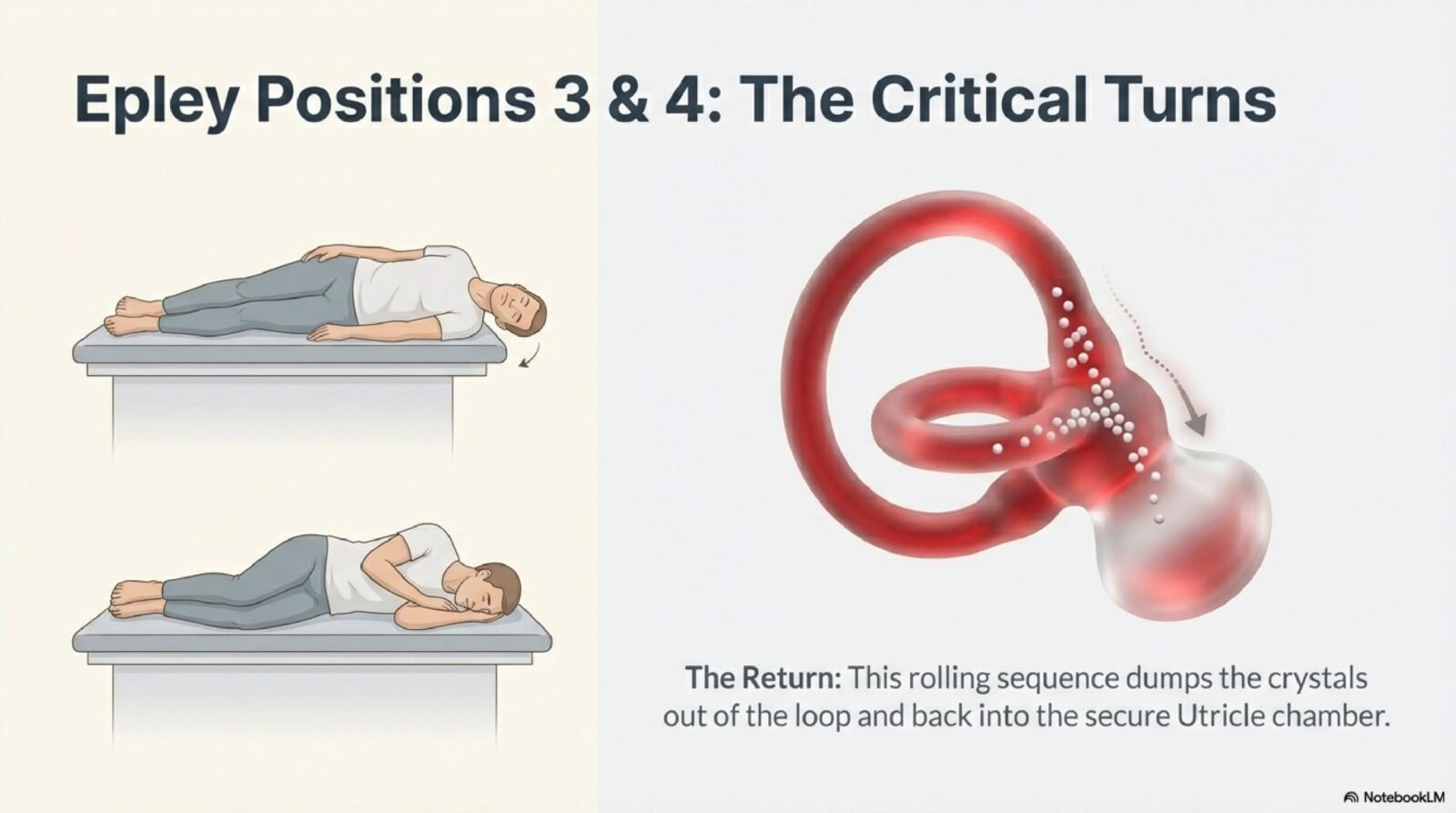
For confirmed posterior-canal BPPV, the Epley maneuver or another appropriate canal-repositioning procedure can guide the particles out of the affected canal. Other canals require different positioning sequences. Some patients improve after one treatment, while others need repeat assessment or a different maneuver. Persistent symptoms should prompt review for unresolved BPPV or another vestibular or neurological cause.
Routine fixed post-maneuver restrictions are not recommended for every patient after posterior-canal repositioning. Individual precautions may still be needed because of neck disease, mobility limitations, fall risk or another clinical factor.

2. Vestibular rehabilitation for selected patients
Vestibular rehabilitation is an exercise-based programme used for selected vestibular disorders, gaze instability, motion sensitivity and balance impairment. It may include gaze-stabilisation, habituation, balance, walking and functional exercises. The programme is adjusted to the diagnosis, symptom response, mobility, vision, neuropathy, joint or neck limitations, and risk of falling.
A fixed internet schedule—such as a set number of repetitions twice daily for everyone—is not appropriate. Mild, brief symptom provocation may be part of some rehabilitation programmes, but severe or prolonged worsening, new neurological symptoms, repeated vomiting, or unsafe walking requires reassessment. For BPPV, generic vestibular exercises do not replace the correct canal-specific maneuver.
3. Everyday measures that may support recovery
- Move safely: if balance is unreliable, use support, improve lighting, remove trip hazards and avoid driving, ladders or unassisted bathing until it is safe.
- Return to activity gradually: unnecessary long-term avoidance can reduce confidence and physical conditioning. The pace should match the diagnosis and fall risk.
- Maintain hydration and regular meals: this can reduce dizziness related to dehydration or missed meals, but it does not reposition BPPV particles or treat every cause of vertigo.
- Keep a symptom record: note timing, duration, positional triggers, headache, hearing changes, medicines, fainting, falls and what improves or worsens the episode.
- Protect sleep and migraine routines: regular sleep, meals and individually recognised triggers can support vestibular-migraine care, but the plan should be personalised.
Salt, caffeine or alcohol restriction should not be presented as a universal vertigo cure. Dietary advice depends on the suspected condition, the patient’s other illnesses and the overall treatment plan.
When medicine may still be necessary
“Without medicine” should not become an anti-medication rule. Medication may be appropriate for severe nausea or vomiting, vestibular migraine prevention, an acute vestibular disorder, anxiety or PPPD as part of a broader plan, Ménière disease, infection, vascular risk, or another diagnosed condition. Some vestibular-suppressant medicines are useful only for a short acute period because prolonged use can interfere with compensation or increase sedation and fall risk.
Do not stop prescribed medicine solely because an article describes a non-medication option. The correct question is whether each treatment matches the confirmed or suspected cause and whether its benefits outweigh its risks for that individual.
Can positioning maneuvers be done at home?
Some patients can learn a home maneuver after BPPV has been confirmed and the affected side and canal are known. Home treatment is not suitable for everyone, especially when the diagnosis is uncertain, symptoms are atypical, there is significant neck or back disease, vascular concern, severe mobility limitation, pregnancy-related positioning difficulty, or a high fall risk. A first supervised assessment helps distinguish BPPV from conditions that need a different response.
How follow-up is used
After observation or treatment for BPPV, follow-up checks whether positional vertigo has resolved and whether imbalance or other symptoms remain. Improvement varies: some people feel better quickly, while others have residual unsteadiness or need repeat treatment. If symptoms persist, the next step is not automatically more of the same exercise; it is reassessment for unresolved BPPV, another peripheral vestibular disorder, migraine, medication effects, cardiovascular causes or a central neurological condition.
Red flags: seek urgent medical care
Do not rely on home exercises or a routine clinic appointment when dizziness or vertigo occurs with:
- new facial droop, arm or leg weakness, numbness, slurred speech or confusion;
- new double vision, collapse, fainting, chest pain or a severe new headache;
- sudden hearing loss in one ear;
- inability to stand or walk safely, repeated vomiting or dehydration;
- a major fall, head injury, or symptoms that are continuous and very different from prior episodes.
Frequently asked questions
Does vertigo treatment without medicine work for every cause?
No. It is highly relevant to confirmed BPPV and useful in selected rehabilitation settings, but other diagnoses may need medication, hearing care, migraine management, cardiovascular assessment, imaging, emergency care or specialist referral.
Is Epley the right maneuver for every positional vertigo episode?
No. Epley is mainly used for posterior-canal BPPV. The affected side, canal and observed eye movements guide the maneuver. Positional symptoms without the expected findings require a broader assessment.
Should everyone do Brandt–Daroff exercises?
No. They may be offered in selected circumstances, but they are not a universal prevention routine and should not replace canal-specific treatment when that is indicated.
Can VNG diagnose every cause of dizziness?
No. VNG testing can document useful eye-movement and vestibular findings, but it is interpreted alongside the history and examination. Typical BPPV often does not require extensive vestibular testing unless findings are unclear or atypical.
What should I bring to a vertigo assessment?
Bring a list of current medicines, relevant reports, hearing changes, the timing and triggers of episodes, headache history, falls or fainting, and any videos of visible eye movements recorded safely during an episode.
August 2026 evidence update
A randomized trial published on 19 August 2026 studied 40 adults with definite vestibular migraine. Both groups completed four weeks of home vestibular rehabilitation; the intervention group also received eight supervised clinic-based virtual-reality sessions. The additional VR group had greater improvement in dizziness-related disability, dizziness severity and selected dynamic-postural-control measures. This small, short, selected trial supports supervised VR as an adjunct for some patients with vestibular migraine; it does not show that virtual reality, home exercises or a single programme treats every cause of vertigo. Kirazli et al., DOI 10.1002/lary.70814.
An August 2026 observational study of lateral-canal BPPV examined canal-specific side determination and repositioning in 146 geotropic and 285 apogeotropic/peripheral cases. Its results support diagnosis- and canal-specific maneuvers, but the non-randomized design and specialised population do not justify a universal success percentage or a fixed recovery time. Shigeno, DOI 10.1016/j.anl.2026.04.013.
Assessment at Prime ENT Center, Hardoi
Assessment begins with the symptom pattern and clinical examination. Positional, hearing or vestibular tests are considered when they are likely to clarify the diagnosis, identify a safety concern or change management. Not every patient requires every test. Online consultation can help review reports and plan next steps, but positional diagnosis and a maneuver often require an in-person examination.
Appointments: 7393062200 (Call/WhatsApp)
Related guides
- BPPV: symptoms, diagnosis and treatment
- How vertigo is diagnosed
- Vertigo red-flag check
- Vestibular migraine guide
- Online consultation information
References
- Clinical Practice Guideline: Benign Paroxysmal Positional Vertigo (Update)
- Vestibular Rehabilitation for Peripheral Vestibular Hypofunction: Updated Clinical Practice Guideline
- Virtual Reality-Based Vestibular Rehabilitation for Vestibular Migraine: A Randomized Trial
- Lateral-canal BPPV side determination and otolith repositioning study
Medical Disclaimer: This article is for educational purposes only and does not constitute medical advice, diagnosis or prescribing guidance. Consult Dr. Prateek Porwal at Prime ENT Center, Hardoi for personalised treatment. New neurological symptoms, sudden hearing loss, inability to walk safely or other emergency features require urgent medical care.
Read next — from Dr. Porwal's vertigo library