
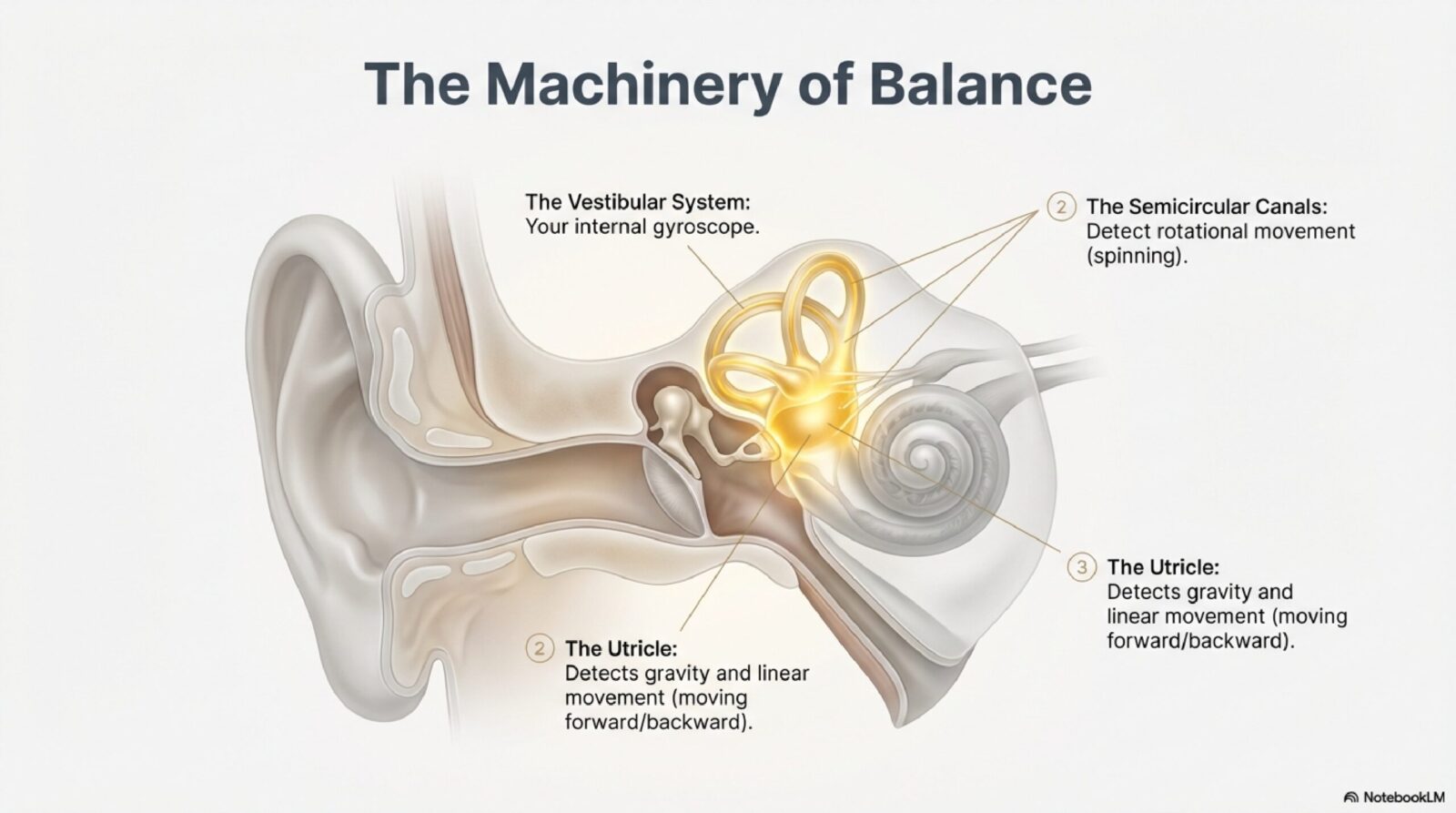
Anterior canal BPPV is a rare positional-vertigo pattern. It can cause brief spinning and positional downbeat nystagmus, but downbeat eye movements are not enough to diagnose it. Central neurological disorders and an atypical posterior-canal pattern can look similar, so diagnosis must come before any maneuver.
Important: new downbeat nystagmus, severe inability to walk, double vision, weakness, slurred speech, a new severe headache, collapse or other neurological symptoms need prompt medical assessment. Do not use a home maneuver to test whether the cause is “ear crystals.”
What is anterior canal BPPV?
BPPV occurs when otoconia move into a semicircular canal and create an abnormal signal during a change in head position. Most BPPV involves the posterior canal. Anterior-canal involvement is much less common and its diagnostic pattern is less straightforward.
Possible symptoms include short attacks of spinning when lying down, looking up, bending forward or getting out of bed. These triggers can support a positional diagnosis, but they do not identify the affected canal by themselves.
Why positional downbeat nystagmus needs caution
Anterior canal BPPV may produce downbeat nystagmus, sometimes with a torsional component, during the Dix–Hallpike test or supine straight-head-hanging test. The same broad finding can occur with central vestibular disorders and with an apogeotropic posterior-canal BPPV variant.
Latency, fatigability and duration may contribute to the interpretation, but none of them makes BPPV “almost certain.” The eye-movement direction, symptom history, neurological findings, response over time and the complete positional-test pattern must be considered together.
How clinicians assess a suspected case
- History: episode duration, positional triggers, hearing symptoms, headache, vomiting, walking difficulty, recent injury and neurological symptoms.
- Examination: eye movements, cranial nerves, cerebellar signs, gait and balance, neck-movement safety and ear examination when relevant.
- Positional testing: bilateral Dix–Hallpike and supine head-hanging tests may be used; repeat testing is sometimes needed when the first examination is inconclusive.
- Video recording: VNG can document nystagmus and help with later review, but it does not independently prove an ear cause or exclude a brain cause.
- Imaging or neurological assessment: considered when the pattern is atypical, neurological findings are present, symptoms persist despite an appropriate maneuver, or diagnostic uncertainty remains.
What Dr. Porwal’s published study found
A 2021 retrospective study co-authored by Dr. Prateek Porwal reviewed 13 confirmed anterior-canal BPPV cases from 1,350 vertigo cases across four referral centres. Positional downbeat nystagmus was not identical in every patient: some had a torsional component, some had a horizontal component and some showed pure downbeat nystagmus. The supine head-hanging test was the most consistent test in that series, but some findings appeared only during Dix–Hallpike testing.
The study supports a structured positional-test protocol and careful pattern interpretation. It was a small retrospective case series, not a randomized treatment comparison, and it does not prove that one maneuver is universally superior.
Treatment options after the pattern is confirmed
Treatment is a clinician-selected canalith-repositioning procedure. Published approaches include the Yacovino or deep head-hanging maneuver and other canal-directed variants. Choice depends on the observed pattern, suspected canal and side, neck or spine limitations, fall risk and diagnostic certainty.
Some patients improve after one treatment; others need a repeat maneuver, a modified approach or reassessment. Persistent symptoms should not automatically lead to repeated maneuvers without reconsidering unresolved BPPV, another peripheral vestibular disorder or a central cause.
Where the Bangalore Maneuver fits
The Bangalore Maneuver patient guide describes a clinician-performed repositioning approach discussed for selected anterior-canal patterns. It should not be presented as a home exercise, an outcome guarantee or a proven replacement for established maneuvers.
What to do before an appointment
- Note the exact movement that triggers the episode and how long it lasts.
- Record hearing change, tinnitus, headache, double vision, weakness, numbness, vomiting, falls or walking difficulty.
- Bring a current medicine list and previous scan, hearing or vestibular reports.
- Do not stop medicines or attempt repeated maneuvers unless the treating clinician gives individualized instructions.
- Arrange support for travel if active vertigo makes walking or driving unsafe.
Frequently asked questions
Does downbeat nystagmus always mean anterior canal BPPV?
No. It can have peripheral or central causes. The full examination and positional pattern determine the next step.
Does every patient need VNG?
No. Video recording can help document an unclear or unusual pattern, but testing is selected according to the clinical question.
Can I try the Epley or Bangalore Maneuver at home?
Not for an unconfirmed downbeat or anterior-canal pattern. The wrong maneuver may delay recognition of another cause and may be unsafe with neck, spine, vascular or mobility problems.
Does failed Epley treatment prove anterior canal BPPV?
No. Failure can reflect the wrong side or canal, an incomplete diagnosis, another vestibular condition or a central disorder. Reassessment is safer than assuming a rare subtype.
Book an assessment
Prime ENT Center, Hardoi
Use the appointment page or call/WhatsApp 7393062200. For sudden neurological symptoms or inability to walk safely, use the nearest appropriate emergency service instead of waiting for a routine appointment.
Related guides
References
- Porwal P et al. Clinical and VNG Features in Anterior Canal BPPV—An Analysis of 13 Cases
- Clinical Practice Guideline: Benign Paroxysmal Positional Vertigo (Update)
- Clinical spectrum of positional downbeat nystagmus: a diagnostic approach
- Diagnostic criteria for central versus peripheral positioning nystagmus and vertigo
Medical disclaimer: This page provides general education and does not diagnose an individual condition or replace an in-person examination. Seek urgent assessment for new neurological symptoms, sudden severe headache, collapse, serious injury, sudden hearing loss or severe inability to stand or walk.
Read next — from Dr. Porwal's vertigo library