Intratympanic treatment for Meniere’s disease means placing medicine through the eardrum into the middle ear so it can act near the inner ear. Steroids and gentamicin are used for different goals, so the choice depends on hearing status, attack severity and risk tolerance.
Table of Contents: Treatment Treatment Meniere
- When is Intratympanic Treatment Needed?
- Intratympanic Steroids (IT-steroid medication)
- Intratympanic an ototoxic antibiotic (IT-an ototoxic antibiotic)
- Steroids vs an ototoxic antibiotic: Head-to-Head Comparison
- My Approach to Choosing Treatment
- What to Expect: The Patient Experience
- FAQ: Intratympanic Treatment for Meniere’s
- Author Bio
I explained intratympanic steroid injections—a procedure where I would inject medication directly into her middle ear through the eardrum. She was terrified of needles and of anything being done to her ear. But I could see the hope in her eyes when I explained this had a 60-70% success rate.
The procedure took 10 minutes. She had three injections over 3 weeks. Within 8 weeks, her attacks dropped from 2-3 per week to 1-2 per month. She returned to work. She could attend her daughter’s school events. This is what proper escalation of treatment can do.
When is Intratympanic Treatment Needed?
We don’t jump to intratympanic treatment right away. It’s reserved for patients who have tried and failed conservative management. Specifically:
Criteria for intratympanic therapy:
– Definite Meniere’s disease diagnosis (not suspected or possible)
– Failed adequate low-sodium diet trial (at least 4-6 weeks at <1,/day sodium)
- Failed adequate diuretic therapy (at least 4-6 weeks on or similar)
- Persistent frequent attacks that significantly impact quality of life
- Adequate hearing in the affected ear (not already deaf)
If a patient has mild occasional attacks and responds partially to diet and medication, we might continue conservative management indefinitely. But for patients like Amita with frequent disabling attacks despite medical therapy, we need to escalate.
Intratympanic Steroids (IT-steroid medication)
What is it?
steroid medication is a potent corticosteroid. We inject it directly through the eardrum into the middle ear space, where it comes into contact with the round window niche that leads to the inner ear. The steroid diffuses into the inner ear fluid and exerts anti-inflammatory effects.
How does it work?
The exact mechanism isn’t fully understood, but we believe the inflammation in Meniere’s disease—particularly in the endolymphatic sac—contributes to symptoms. steroid medication reduces this inflammation, allowing the inner ear to function better and reducing attack frequency.
👉 Also read: intratympanic injections for Meniere’s disease
The procedure:
This takes 10-15 minutes in my office under local anesthesia. I use a needle or small catheter to inject steroid medication through a small opening in the eardrum (tympanometry). The patient sits back at about 45 degrees for 30 minutes to allow the medication to diffuse into the inner ear. No surgery, no general anesthesia.
The procedure is uncomfortable but not painful with adequate anesthesia. Most patients describe a sensation of pressure in the ear but no severe pain.
Side effects?
Minimal. The hole in the eardrum heals within days. There’s no risk of hearing loss from the medication itself. Some patients have temporary conductive hearing loss (plugged ear sensation) for a few days while the eardrum heals. Rarely, persistent eardrum perforation happens (less than 1% of cases).
How many injections?
The standard protocol is a series of 3-4 injections given 1-2 weeks apart. Some patients respond to 1-2 injections. Others need all 4. We assess response after each injection before deciding on additional ones.
Success rate?
About 60-70% of patients get significant improvement (at least 50% reduction in attack frequency). About 10-15% get complete resolution. Some patients get no benefit. Success rate is better in early-stage disease compared to late-stage.
Duration of benefit?
Most patients who respond see benefit last 6-12 months or longer. Some need repeat injections every 6-12 months. Long-term data suggests the benefit can last years in some patients.
Advantages:
– No systemic side effects (injected directly in ear, not swallowed)
– No risk to hearing
– Office procedure, no anesthesia
– Reversible (if problems occur, simply stop injections)
– Can be repeated as needed
👉 Also read: Intratympanic Injections for Meniere’s Disease: Steroid vs
Why I often choose intratympanic steroids first:
They’re safer than an ototoxic antibiotic (no hearing loss risk), can be repeated, and have good efficacy. They’re my preferred next step after failed medical therapy.
Intratympanic an ototoxic antibiotic (IT-an ototoxic antibiotic)
What is it?
an ototoxic antibiotic is an antibiotic that’s toxic to the vestibular (balance) system when concentrated in high doses in the inner ear. By injecting it into the middle ear, we can selectively damage the diseased vestibular system on that side while attempting to preserve hearing.
How does it work?
This is what we call a “chemical labyrinthectomy.” The an ototoxic antibiotic destroys the vestibular cells on that side. If the vestibular system isn’t working, it can’t send conflicting signals to the brain, and vertigo attacks stop.
The brain’s balance system compensates by relying more on the other ear, proprioception (body position sense), and vision. Most patients adapt remarkably well.
The procedure:
Similar to steroid injection—office procedure with local anesthesia, injection through the eardrum, 30-minute dwell time. Sometimes we do it as a single dose, sometimes as a mini-dose series (lower concentration, 2-3 injections).
Success rate for vertigo control?
Excellent—70-80% of patients get complete or near-complete vertigo control. This is higher than steroids. It’s very effective at stopping vertigo attacks.
The risk: Hearing loss
Here’s the major limitation: an ototoxic antibiotic can damage hearing by 5-15%. This is a real risk. I only use an ototoxic antibiotic when:
1. The patient’s hearing in that ear is already poor
2. Steroids have failed
3. The patient understands and accepts the hearing loss risk
4. Vertigo is so severe it’s devastating the patient’s life
👉 Also read: Meniere’s Disease, Complete Guide for Indian Patients
We use dosing strategies to minimize hearing loss—lower concentrations and mini-dose protocols instead of single high-dose injections.
Advantages of an ototoxic antibiotic:
– Highest success rate for vertigo control (70-80%)
– Very durable effect (doesn’t usually need repeating)
– When successful, patient gets relief from vertigo permanently
Disadvantages:
– Risk of hearing loss
– Irreversible—once the vestibular system is damaged, it’s damaged
– Used only after other options fail
Steroids vs an ototoxic antibiotic: Head-to-Head Comparison
| Feature | Intratympanic Steroids | Intratympanic an ototoxic antibiotic |
|---|---|---|
| Mechanism | Anti-inflammatory | Vestibular destruction (chemical labyrinthectomy) |
| Vertigo Control Rate | 60-70% | 70-80% |
| Hearing Loss Risk | NO | 5-15% |
| Reversible? | YES – can stop anytime | NO – permanent change |
| Can Be Repeated? | YES – as many times as needed | Once (rarely repeated if failed) |
| Duration of Benefit | 6-12 months (can repeat) | Permanent (when successful) |
| Procedure Time | 10-15 minutes | 10-15 minutes |
| Anesthesia | Local only | Local only |
| Side Effects | Minimal | Possible hearing loss |
| Cost | Lower | Similar |
| Preferable For | Early disease, good hearing, first injection | Poor hearing, intractable disease, failed steroids |
My Approach to Choosing Treatment
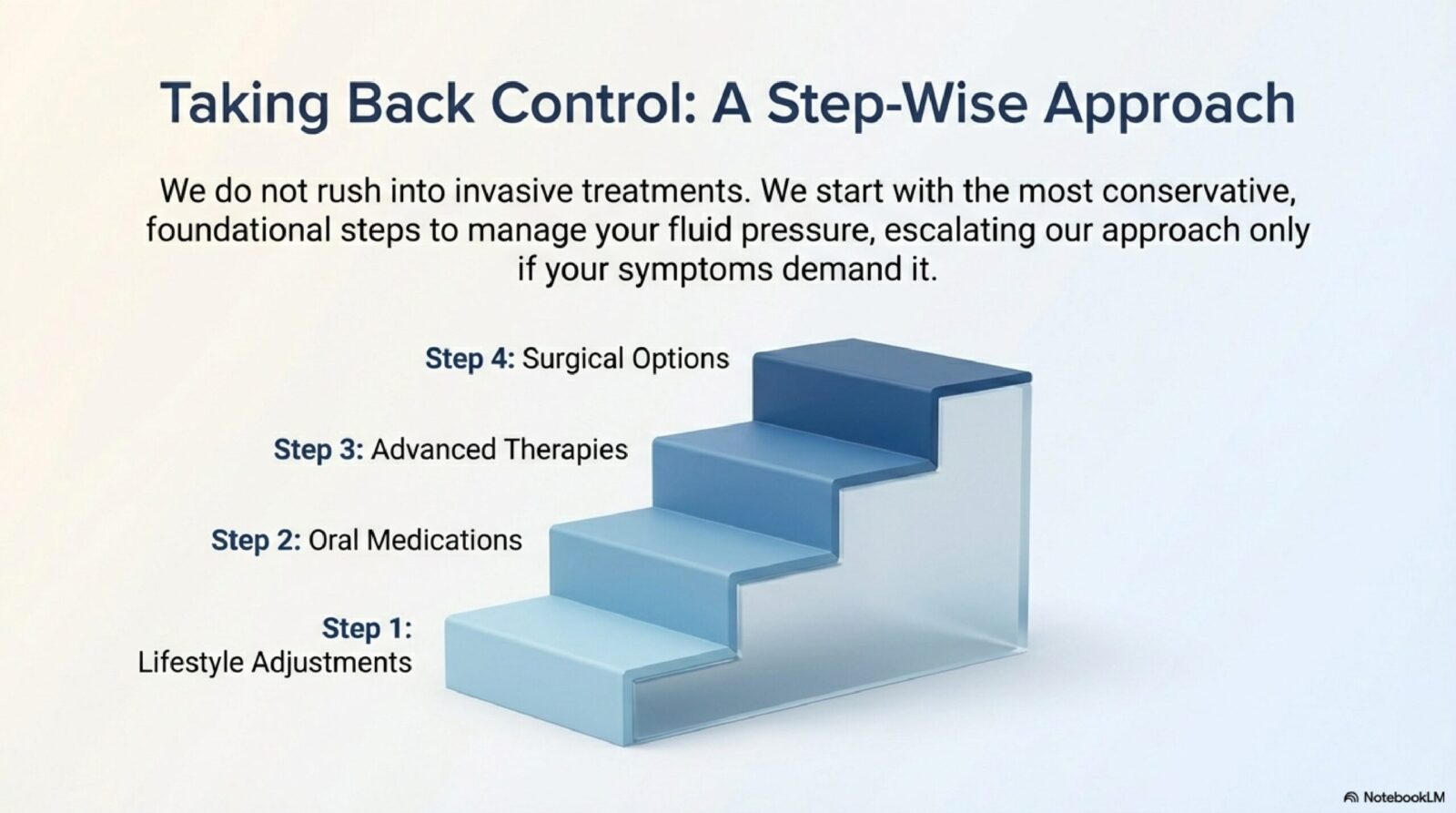
For patients who have failed conservative management, I typically follow this sequence:
Step 1: Intratympanic Steroids
I start with steroid medication injections because they have no hearing loss risk and can be repeated. If the patient responds well, problem solved. If partial response, we can continue or add systemic medications. If no response, we move to the next step.
Step 2: If Steroids Fail:
At this point, we assess the patient’s hearing. If hearing is still good, we might:
– Increase diuretic dose
– Add different medications
– Do more rounds of steroid injections
– Consider an ototoxic antibiotic if patient is very symptomatic
If hearing is already significantly compromised, an ototoxic antibiotic becomes more attractive because the hearing loss risk is less of a concern.
👉 Also read: Electrocochleography (ECochG), Diagnosing Meniere’s Disease Precisely
Step 3: Surgical Options
If intratympanic treatments fail and the patient has intractable disease, surgical options like endolymphatic sac decompression or labyrinthectomy are considered.
What to Expect: The Patient Experience
Before the procedure:
I examine the patient’s eardrum to make sure it’s intact. We document baseline hearing and balance function. I discuss the procedure, answer questions, address anxiety.
During the procedure:
Local anesthetic drops are placed in the ear. The patient feels cold drops but no pain. I identify the eardrum and inject the medication through it. The patient feels pressure, sometimes a slight clicking or popping sensation. It’s uncomfortable but tolerable. The whole thing takes 10-15 minutes.
After the procedure:
The patient sits back for 30 minutes to allow medication to diffuse into the inner ear. During this time, they might feel:
– Ear fullness
– Slight hearing change (plugged sensation)
– Mild dizziness or imbalance
– These resolve within hours to days
Most patients go home afterward. They’re cautious with water in the ear (the eardrum has a small opening) for 1-2 weeks until it heals. No strenuous activity for a day or two.
Recovery:
The eardrum heals completely in 3-7 days. By 2-3 weeks, any temporary hearing change resolves. If benefit is going to occur, it usually becomes apparent within 2-4 weeks and continues improving over 6-12 weeks.
FAQ: Intratympanic Treatment for Meniere’s
Author Bio
Dr. Prateek Porwal, MBBS, DNB ENT, CAMVD | ENT & Vertigo Specialist has performed hundreds of intratympanic steroid and an ototoxic antibiotic injections for Meniere’s disease patients at Prime ENT Center, Hardoi, UP. He believes in exhausting medical options before considering surgical intervention, and in discussing risks and benefits thoroughly so patients can make informed decisions.
If If you have Meniere’s disease that’s not responding to diet and medications, intratympanic treatment might be the answer. Schedule a consultation to discuss your options.
Call 7393062200 or WhatsApp https://wa.me/917393062200
Prime ENT Center, Hardoi, UP
Website: drprateekporwal.com
Medical Disclaimer: This article is for educational purposes only and does not constitute medical advice, diagnosis or prescribing guidance. All medications must be taken under direct supervision of a qualified physician. Consult Dr. Prateek Porwal at Prime ENT Center, Hardoi for personalised treatment.
References
- Committee on Hearing and Equilibrium guidelines for the diagnosis and evaluation of therapy in Meniere’s disease. Otolaryngology–Head and Neck Surgery. 1995;113(3):181–185.
- Thirlwall AS, Kundu S. Diuretics for Ménière’s disease or syndrome. Cochrane Database of Systematic Reviews. 2006;(3):CD003599.
- Pullens B, van Benthem PP. Intratympanic an ototoxic antibiotic for unilateral Menière’s disease or syndrome. Cochrane Database of Systematic Reviews. 2011;(3):CD008234.
