
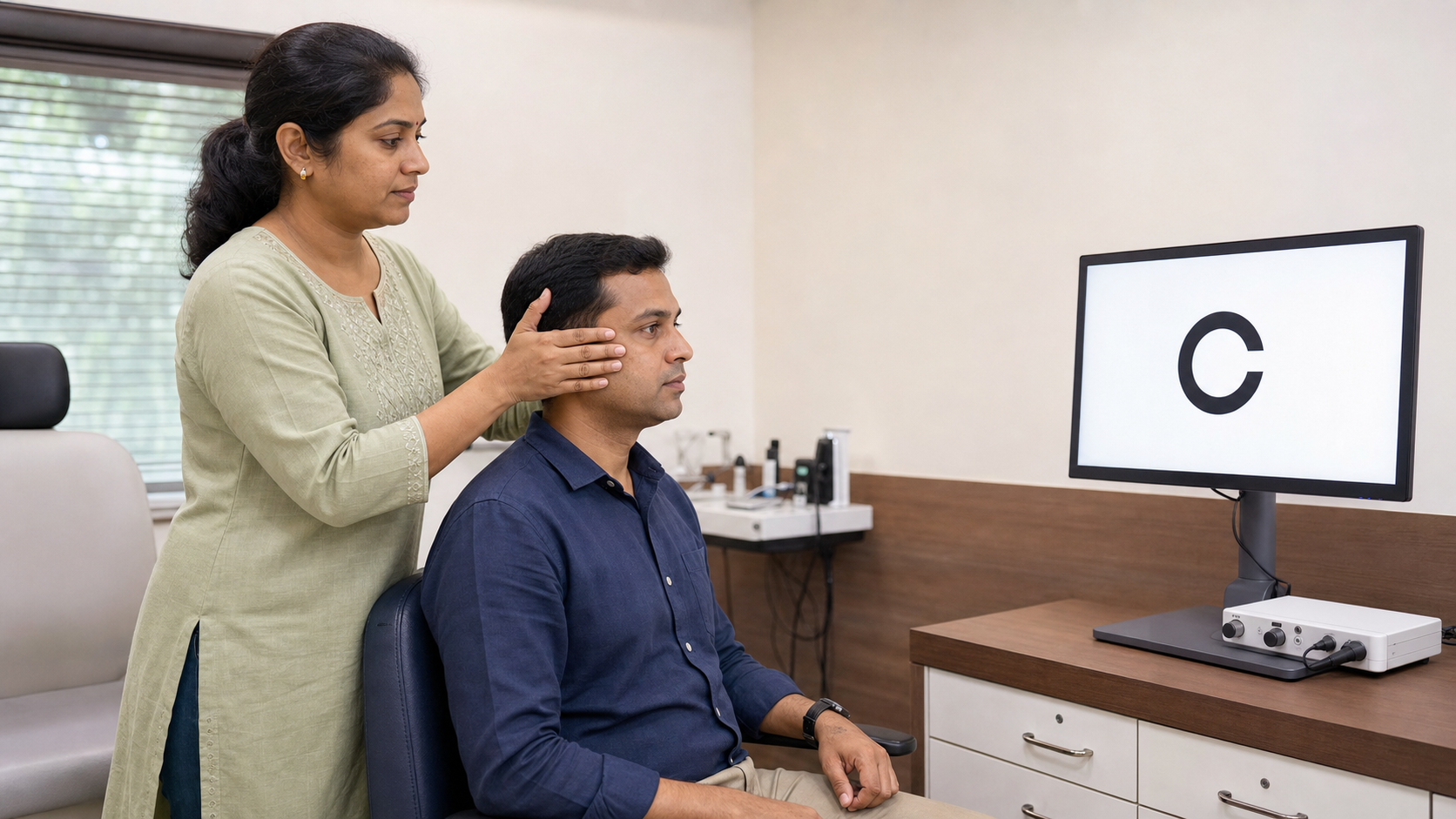
Functional head impulse test (fHIT) checks how well a person can keep vision functionally clear during small, rapid head movements. During the test, a trained clinician applies controlled head impulses while the patient identifies the direction of a briefly displayed visual symbol. fHIT can add useful information about gaze stability, but it does not diagnose every cause of dizziness and is interpreted with the history, examination and other selected vestibular tests.
On this page
- What fHIT measures
- Who may be considered for fHIT
- Procedure and preparation
- Understanding fHIT results
- fHIT, VNG, vHIT and posturography
- Limitations and safety boundaries
- fHIT at Prime ENT Center
- Frequently asked questions
What does the functional head impulse test fHIT measure?
The vestibulo-ocular reflex helps keep an image stable on the retina while the head moves. The fHIT vestibular test looks at the functional result of that reflex: can the patient correctly recognise a visual target during a brief head impulse?
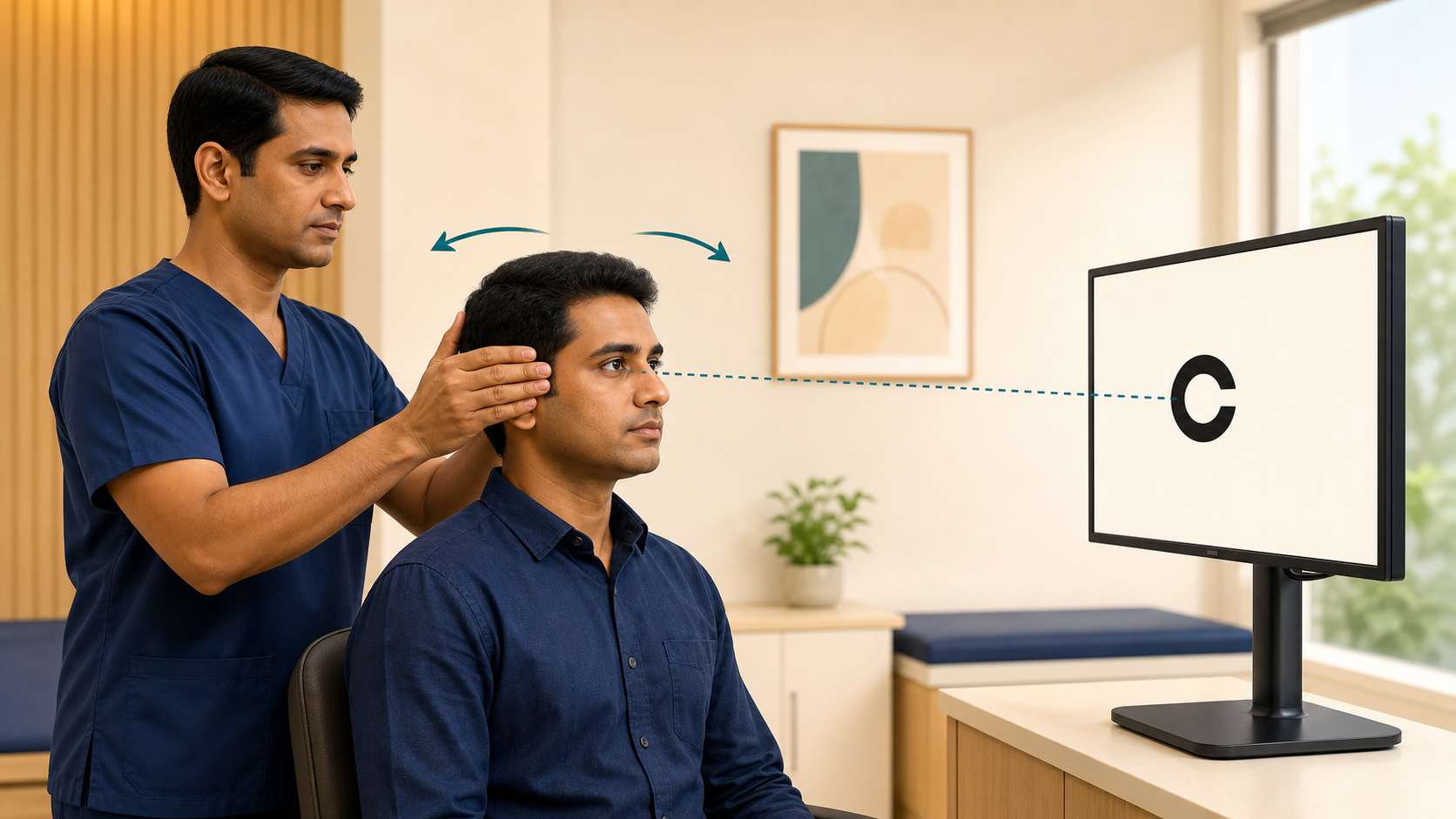
A commonly used target is a Landolt C, a ring with a gap pointing in one direction. The target appears for a very short time during head movement, and the patient reports the gap direction. The system calculates the percentage of correct answers across selected head accelerations. Research describes fHIT as a measure of functional visual performance during rapid head movement rather than a stand-alone label for a particular disease.
This makes fHIT related to, but different from, the video head impulse test (vHIT). vHIT records eye and head movements to calculate vestibulo-ocular reflex gain and corrective saccades. fHIT asks whether the combined response is effective enough for the patient to recognise a brief visual symbol.
Who may be considered for an fHIT test for dizziness?
A clinician may consider an fHIT test for dizziness when the symptom pattern suggests impaired gaze stability during movement. Patients may describe blurred or bouncing vision while walking, difficulty seeing clearly when turning the head, imbalance in visually demanding places or persistent motion-related symptoms after a vestibular disorder.
- Suspected unilateral or bilateral vestibular weakness.
- Persistent oscillopsia or reduced visual clarity during head movement.
- Follow-up after a vestibular disorder when functional recovery needs assessment.
- Symptoms that require comparison with vHIT, dynamic visual acuity or another selected balance test.
- Vestibular rehabilitation planning or progress review when the result could change management.
Not every person with vertigo needs fHIT. Brief spinning only when rolling in bed may first require positional testing for BPPV. Faintness may need blood-pressure, cardiac, metabolic or medicine review. Sudden continuous vertigo with neurological warning signs requires urgent clinical assessment rather than routine outpatient testing.
How is the functional head impulse test performed?
The patient sits at a defined distance from a monitor and learns how to identify the orientation of the visual target. The clinician then delivers small, rapid and unpredictable head impulses in the plane being assessed. The target is displayed briefly in relation to the head movement, and the patient indicates the direction of its gap.
Head impulses should be applied by a trained examiner. The movement is quick but limited in range; it is not a forceful neck manipulation. Test configuration, number of impulses and canals assessed can vary according to the equipment, the patient’s condition and the clinical question.
How should a patient prepare?
- Bring current glasses if they are normally used for distance vision.
- Tell the clinician about neck pain, recent neck injury, restricted movement or previous neck surgery before testing.
- Bring relevant hearing, VNG, imaging or earlier vestibular reports.
- Ask the clinic before changing any medicine. Do not stop prescribed treatment solely for an online test-preparation list.
- Report severe nausea, visual difficulty or discomfort during the assessment.
The appointment length depends on whether fHIT is performed alone or as part of a broader vestibular evaluation. Confirm the planned tests, preparation and current charges with the clinic before travelling.
What do fHIT results mean?
fHIT results are commonly expressed as the percentage of correctly identified visual targets at selected head accelerations and movement planes. A lower-than-expected percentage may indicate reduced functional gaze stability during those impulses. Side-to-side or plane-specific differences may also help the clinician frame the result.
The result is not interpreted from one number in isolation. Age, visual acuity, attention, understanding of the task, examiner technique, head acceleration, the canal plane being tested and the device’s reference data can influence performance. An abnormal result does not by itself prove BPPV, vestibular neuritis, migraine, stroke or another named disorder.
Published studies have found that fHIT and vHIT can both change during recovery from vestibular neuritis, while their numerical outputs do not necessarily correlate. That is expected because the tests ask different questions: vHIT quantifies eye-head responses, whereas fHIT measures functional visual recognition during head movement.
fHIT vs VNG, vHIT and posturography
| Test | Main question | What it does not replace |
|---|---|---|
| fHIT | Can the patient recognise a brief visual target during controlled head impulses? | Clinical history, neurological assessment, positional testing or hearing evaluation when indicated. |
| vHIT | What are the measured eye-head response, gain and corrective saccade patterns during head impulses? | Functional visual performance, caloric testing or a complete acute-dizziness examination. |
| VNG | What eye-movement and nystagmus patterns appear during selected oculomotor, positional or caloric tasks? | Every vestibular frequency range, hearing assessment or brain imaging when clinically needed. |
| Posturography | How does balance performance change under selected sensory conditions? | Canal-specific vestibular testing or diagnosis from symptoms alone. |
The right combination depends on the patient’s timing, triggers, hearing symptoms, eye findings, gait and clinical examination. Read more about VNG assessment for vertigo and the posturography balance test. More testing is not automatically better; a test is useful when it answers a defined clinical question.
Limitations and safety boundaries
fHIT is non-invasive, but it requires rapid head movements and reliable visual responses. Neck restriction, significant pain, poor visual acuity, difficulty understanding the response task or inability to tolerate repeated impulses can limit testing. The clinician should adapt or stop the test when the movement is unsuitable.
The test should not be used as a home stroke screen. New facial weakness, limb weakness or numbness, slurred speech, double vision, collapse, severe new headache or neck pain, inability to stand or walk, sudden hearing loss or persistent severe vomiting needs urgent assessment through an appropriate emergency pathway.
fHIT at Prime ENT Center, Hardoi
Prime ENT Center lists functional head impulse testing as part of its vestibular-lab capability. Testing is selected after the symptom history and clinical examination; it is not assumed as a fixed package for every dizzy patient. Depending on the pattern, the assessment may also involve positional testing, hearing evaluation, VNG, posturography or another targeted investigation.
For non-emergency questions about current availability, preparation and charges, call or WhatsApp +91 7393062200. Patients travelling to Hardoi should confirm the planned assessment before making a long journey.
Frequently asked questions
Is fHIT the same as vHIT?
No. Both use head impulses, but they produce different information. vHIT measures eye and head movement responses, including gain and corrective saccades. fHIT measures whether the patient can recognise a brief visual target during head movement.
Can fHIT diagnose the cause of vertigo by itself?
No. fHIT results must be interpreted with the symptom pattern, clinical examination and other selected tests. It does not independently diagnose BPPV, migraine, neuritis, stroke or every cause of dizziness.
Does the functional head impulse test hurt?
The test uses small, rapid head movements rather than forceful manipulation. Some patients may briefly feel dizziness or nausea. Tell the examiner about neck problems before testing and report discomfort immediately.
Can I take my usual medicines before fHIT?
Ask the clinic for instructions based on the planned test battery and your prescriptions. Do not stop a prescribed medicine without advice from the clinician responsible for it.
How much does fHIT cost in India?
Charges vary by clinic and by whether fHIT is performed alone or with other vestibular tests. Prime ENT Center does not publish a fixed package price on this page; confirm the current charge and the clinically planned tests before booking.
References
- Versino M, et al. The functional head impulse test: comparing gain and percentage of correct answers. Progress in Brain Research. 2019.
- Evaluation of vestibulo-ocular reflex with functional head impulse test in healthy individuals: normative values.
- Romano F, et al. Functional Head Impulse Test in Professional Athletes: Sport-Specific Normative Values and Implication for Sport-Related Concussion. Frontiers in Neurology. 2019.
- The Video Head Impulse Test: physiological basis, practical aspects and interpretation.
Medical Disclaimer: This article is for educational purposes only and does not constitute medical advice, diagnosis or prescribing guidance. Consult Dr. Prateek Porwal at Prime ENT Center, Hardoi for personalised treatment.