
Room spinning when lying down is one of the most recognizable BPPV symptoms. Quick answer: If the room spins when you lie down, turn over in bed, look up, or sit up, and the spinning lasts seconds to less than a minute, BPPV is one of the most common explanations.
BPPV is an inner-ear balance problem where tiny calcium crystals move into the wrong canal. It is usually treatable with the correct repositioning maneuver. But if the dizziness is continuous, comes with weakness, double vision, slurred speech, chest pain, fainting, sudden hearing loss, severe headache, or inability to walk, seek urgent medical care.
Useful next guides:
What causes BPPV? · Posterior canal BPPV · Dix-Hallpike test · Epley maneuver · Chakkar meaning
Why does the room spin when lying down?
This is the question almost every patient asks me first about room spinning when lying down.
Patients often describe this as “the room spins,” “the bed is moving,” “my head spins when I turn,” or “I feel vertigo when I lie flat.” The key detail is whether the symptom is a true spinning sensation and whether it is triggered by head position.
In BPPV, the spinning usually appears with specific movements: lying back, rolling to one side, turning in bed, getting up from bed, bending forward, or looking upward.
The attack can feel intense, but it is usually brief. Nausea can happen. Between attacks, some people feel mildly off-balance or anxious about moving their head.
What happens inside the inner ear in BPPV?
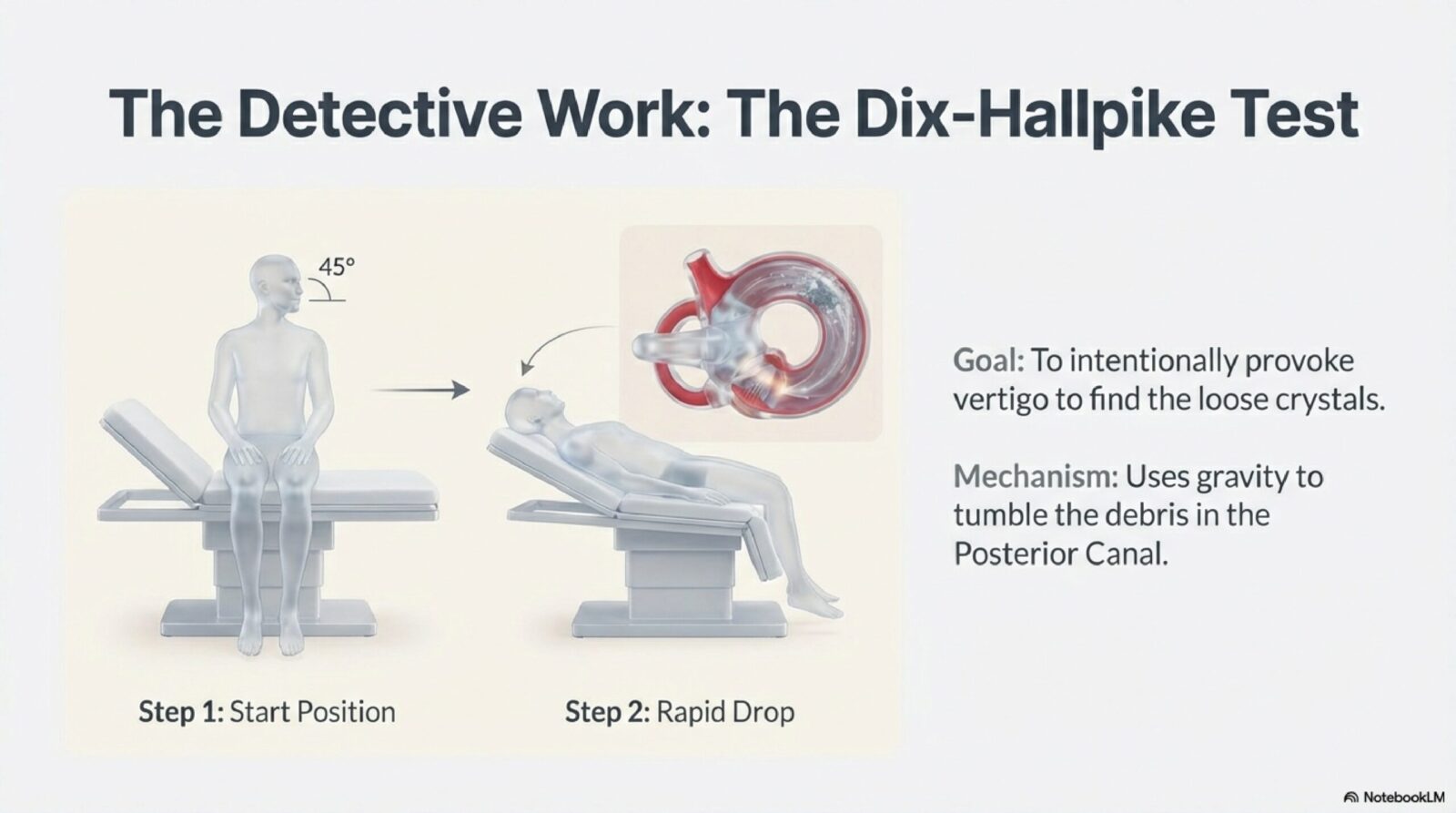
The balance part of the inner ear contains canals that sense head rotation and otolith organs that sense gravity and straight-line movement. Tiny calcium particles normally sit in the otolith organs. In BPPV, some particles move into a semicircular canal.
When you lie down or roll over, those particles shift with gravity and send a false movement signal. The eyes then make a matching reflex movement, called nystagmus, and the brain experiences this mismatch as spinning vertigo.
This is why BPPV is so position-specific. A patient may feel fine while sitting still, but the room spins when lying back or turning to one side.
It also explains why the right maneuver can work quickly: the goal is to guide the particles out of the canal rather than simply suppress the symptom.
The classic BPPV pattern
Recognizing this pattern helps confirm that room spinning when lying down is caused by BPPV rather than another condition.
- Spinning starts after a head-position change.
- Each episode lasts seconds, often under one minute.
- The same movement can trigger it repeatedly.
- Turning in bed or lying down is a common trigger.
- There may be nausea, but there is usually no new hearing loss.
The most common type is posterior canal BPPV, but horizontal canal BPPV can cause strong spinning when rolling left or right in bed. The correct maneuver depends on the canal and side involved, so testing matters.
When it may not be BPPV
Not every lying-down spinning episode is BPPV. Vestibular migraine can cause vertigo that lasts minutes to hours and may come with light sensitivity, sound sensitivity, motion sickness, nausea, or a migraine history.
Vestibular neuritis can cause prolonged spinning for hours or days, often after a viral illness. Meniere disease may include vertigo with ear fullness, tinnitus, and fluctuating hearing.
Blood pressure drops, dehydration, anemia, low sugar, anxiety-related hyperventilation, medication side effects, and heart rhythm problems can also be described as dizziness in bed, although they often feel more like faintness or lightheadedness than room-spinning vertigo.
Red flags: when lying-down dizziness needs urgent care
Go to emergency care urgently if room spinning or dizziness comes with any of the following:
- Weakness or numbness on one side of the body
- Slurred speech, confusion, facial droop, or new severe imbalance
- Double vision, new vision loss, or inability to walk straight
- Chest pain, fainting, severe breathlessness, or palpitations
- Sudden severe headache unlike your usual headache
- Sudden hearing loss, especially in one ear
- Continuous vertigo that does not settle, repeated vomiting, or dehydration
How doctors confirm BPPV
Confirming the diagnosis is the first step before treating room spinning when lying down.
The history gives the first clue, but BPPV is usually confirmed by positional testing. The Dix-Hallpike test checks for posterior canal BPPV.
The supine roll test checks for horizontal canal BPPV. During these tests, the doctor looks for a specific eye movement called nystagmus and matches it with the patient’s symptoms.
VNG can help document eye movements and vestibular patterns, especially when symptoms are confusing, recurrent, or not matching a typical BPPV pattern. Hearing testing is useful if there is tinnitus, ear fullness, or hearing loss.
How to prepare for a vertigo appointment
Before the visit, note which side triggers the spinning, whether it happens when lying back or rolling left/right, how long each episode lasts, and whether nausea, headache, hearing change, tinnitus, ear fullness, faintness, or weakness occurs.
Bring a list of medicines, especially BP tablets, diabetes medicines, sleeping pills, anxiety medicines, antihistamines, and previous vertigo tablets.
If possible, avoid driving yourself to the appointment when symptoms are active. Some positional tests intentionally reproduce vertigo for a short time, so having someone accompany you is safer.
Do not stop essential medicines without medical advice, but do tell the doctor what you took before the visit because sedating medicines can sometimes reduce visible findings during testing.
Treatment: the maneuver should match the canal
Getting this right is essential for resolving room spinning when lying down quickly.
For BPPV, treatment is usually mechanical, not just tablets. The aim is to move the displaced crystals out of the sensitive canal. The Epley maneuver is commonly used for posterior canal BPPV.
The BBQ roll or Gufoni maneuver may be used for some horizontal canal cases. The Semont maneuver is another option in selected posterior canal cases.
Doing random vertigo exercises from the internet can make symptoms worse if the canal and side are not identified. A patient with horizontal canal BPPV may not improve with a posterior-canal maneuver. A patient with vestibular migraine or neuritis needs a different plan.
What to do at home during an episode
- Sit or lie still until the spinning settles.
- Avoid driving, biking, ladders, swimming, or machinery until safe.
- Stand up slowly and use support when walking.
- Hydrate well, especially if vomiting or sweating is present.
- Keep a symptom diary: side, trigger, duration, nausea, hearing symptoms, headache, and medicines.
If you already have a confirmed BPPV diagnosis and your doctor has taught the correct maneuver, follow that specific plan. If this is the first episode, if symptoms are different from before, or if red flags are present, get evaluated first.
Why tablets alone may not solve positional spinning
Medicines can reduce nausea or severe acute vertigo in selected situations, but they do not reposition BPPV crystals. Long-term use of sedating vertigo medicines can make balance slower to recover and may increase fall risk in some patients.
Recurrent room-spinning episodes need a cause-based plan: positional testing, correct maneuver, recurrence prevention, and vestibular rehabilitation when needed.
Recurrence: why it can come back
Many patients ask why room spinning when lying down returns even after successful treatment.
BPPV can recur, especially after head injury, long bed rest, older age, vitamin D deficiency, osteoporosis, migraine tendency, or previous BPPV episodes.
Recurrence does not mean treatment failed; it means the same inner-ear crystal problem may have returned. If attacks keep coming back, the doctor may review vitamin D, bone health, migraine, vestibular rehab, and fall risk.
Special caution for older adults
In older adults, brief positional vertigo can still lead to serious injury because a sudden spin may cause a fall. Night-time bathroom trips, dark rooms, loose rugs, slippers, stairs, and sudden standing after lying down all increase risk.
Until the pattern is controlled, use good lighting, sit at the edge of the bed before standing, keep support nearby, and avoid rushing to walk during an attack.
Older patients may also have more than one cause at the same time: BPPV plus low blood pressure, neuropathy, anemia, medication side effects, or weak balance reflexes. That is why repeated falls or persistent unsteadiness should not be dismissed as “just vertigo.”
Room spinning vs faintness vs imbalance
Use clear words when explaining symptoms. “Room spinning” usually means vertigo. “I may pass out” suggests presyncope or faintness. “I am unsteady when walking” suggests imbalance.
“My head feels heavy” may point to migraine, anxiety, sinus pressure, medication effects, or general illness. The more precise the description, the faster the diagnostic path becomes.
FAQ: room spinning when lying down
Here are the questions I hear most often about room spinning when lying down.
Is room spinning when lying down always BPPV?
No. BPPV is common when spinning is brief and triggered by turning in bed, but migraine, inner-ear inflammation, Meniere disease, blood pressure, medication effects, and neurological causes can mimic it.
Which side is affected in BPPV?
The affected side depends on positional testing and the direction of nystagmus. Symptoms alone are not always enough to identify the side safely.
Can I do the Epley maneuver at home?
If BPPV is confirmed and your doctor has shown the correct side and technique, home maneuvers may be part of the plan. If this is a first episode or red flags are present, get evaluated first.
Why do I feel off-balance after the spinning stops?
Some patients have residual dizziness after BPPV. It can improve over days, but persistent imbalance may need vestibular rehabilitation or re-checking for another cause.
When should I see an ENT or vertigo specialist?
See an ENT or vertigo specialist if attacks recur, are strongly position-triggered, include ear symptoms, do not match a simple pattern, or do not improve after the correct maneuver.
For recurrent room-spinning vertigo: Call or WhatsApp +91 7393062200 for non-emergency consultation with Dr. Prateek Porwal.
Reference
Medical Disclaimer: This article is for educational purposes only and does not constitute medical advice, diagnosis or prescribing guidance. Consult Dr. Prateek Porwal at Prime ENT Center, Hardoi for personalised treatment. Seek urgent medical care for neurological symptoms, chest pain, fainting, sudden hearing loss, severe headache or inability to walk.
Read next — from Dr. Porwal's vertigo library