Note: This article mentions medicine names for educational purposes only. All medications should only be taken under your doctor’s supervision. Doses and duration depend on your individual condition.

Meniere’s disease surgery is considered when medical management fails. Here’s what you should know. Surgically, we is something I see regularly in my practice. A patient came to my clinic last month and said, “Doctor, I can’t live like this anymore. How do I know when I can have surgery?” She’d been on every medication, followed a strict diet, done vestibular rehabilitation, and still having 2-3 disabling vertigo attacks per week. This post covers menieres surgery in detail.

This is when I talk about surgery. Not as a first option, but as a real option when medicine isn’t working.

Related Reading

Understanding Surgically, We

When Do You Need Surgery for Meniere’s?

This is the first question I ask. Because surgery for Meniere’s should be a last resort. It should be considered only when:

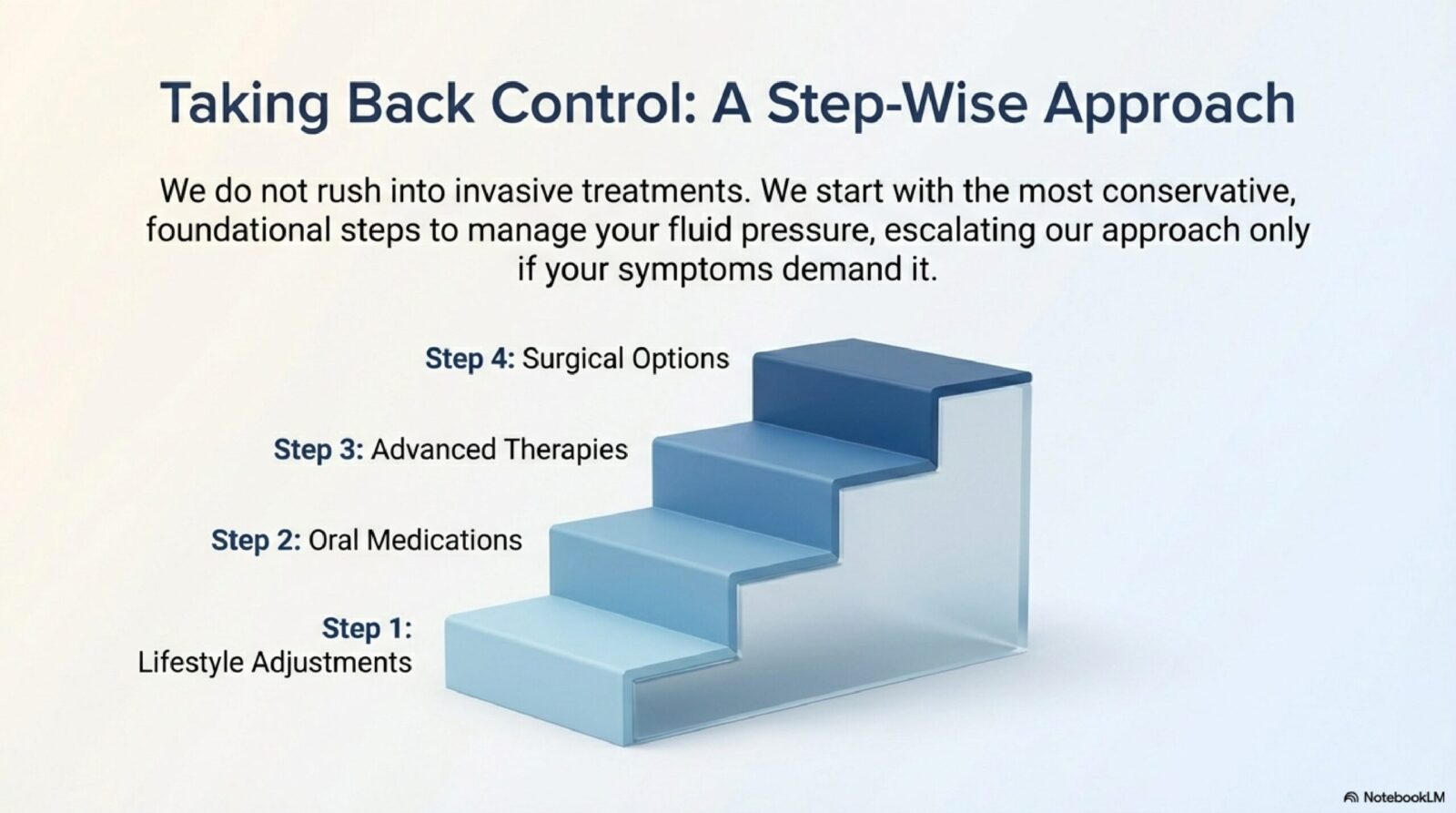
Educational diagram showing the complete treatment ladder for Meniere's disease — from dietary and m

I don’t send a patient to surgery because of one bad attack. I send them when they tell me, “I can’t work. I can’t drive. I can’t leave my house without fear.”

The timing matters too. Early Meniere’s, you might not need surgery ever. But late-stage Meniere’s with frequent attacks and already-severe hearing loss? Surgery becomes reasonable.

Option 1: Intratympanic Gentamicin Injections

This is technically not surgery—there’s no incision—but it’s an invasive procedure I often try before true surgery.

Gentamicin is an antibiotic that’s toxic to vestibular tissue. When injected directly into the middle ear (via needle through the eardrum), it slowly damages the vestibular system, reducing vertigo attacks.

The idea: if the inner ear isn’t working properly, it can’t send the chaotic signals that cause vertigo.

How it works: I inject gentamicin once, sometimes twice, spaced weeks apart. About 70-80% of patients see significant vertigo reduction.

The catch: gentamicin is non-selective. It can damage hearing too. About 20-30% of patients experience some hearing loss after gentamicin. And about 10% develop disequilibrium—not spinning, but walking feels unstable, like the floor is moving.

When I recommend it: The affected ear already has poor hearing or is deaf. Or the vertigo is so disabling that a 20% risk of further hearing loss is acceptable. Or the patient wants to avoid true surgery.

Recovery: Usually 2-3 weeks. Most people feel better within a month. The vertigo often doesn’t improve immediately—it takes time for the damage to take effect.

Option 2: Endolymphatic Sac Surgery

This is true surgery—requires an operating room, general anesthesia, ear canal incision, microscope.

The idea: The endolymphatic sac is where the excess lymph (fluid) in Meniere’s drains. If we decompress it surgically, we might reduce fluid buildup and improve vertigo.

How it works: I make an incision behind the ear, open the mastoid bone, find the endolymphatic sac, and decompress it—sometimes just opening it, sometimes placing a shunt to help fluid drain better.

Evidence: This is controversial. Some studies show 50-60% improvement in vertigo. Other studies show it’s barely better than placebo. The procedure fell out of favor because the evidence wasn’t solid.

When I recommend it: Rarely. Only if a patient wants to try something less destructive than labyrinthectomy or vestibular nerve section, and they understand the evidence is weak. It preserves hearing potential and preserves vestibular function if it works.

Recovery: 2-3 weeks. More significant than gentamicin injections because it’s actual surgery.

Option 3: Vestibular Nerve Section

This is major surgery. It’s destructive and final.

The idea: The vestibular nerve sends dizziness signals from the affected inner ear. If we cut the nerve, those signals stop. No nerve, no dizzy signals.

How it works: Neurosurgeon (usually, or a very specialized ENT) makes an incision, approaches the internal auditory canal, identifies the vestibular nerve, and cuts it. The auditory nerve stays intact, so hearing is theoretically preserved.

Results: 90%+ of patients have Complete resolution of vertigo attacks. This is the most effective procedure for controlling vertigo.

The catch: It’s major surgery. It requires hospital stay, general anesthesia, significant recovery time. There are risks—facial nerve injury, hearing loss (even though the auditory nerve is spared, the surgery can damage it), cerebrospinal fluid leak, infection.

And it’s not widely available. I don’t do this procedure myself. I refer to specialized neurosurgeons in larger cities.

When I recommend it: Only for severely disabling, treatment-resistant Meniere’s in a young patient (better recovery) with good health who can undergo neurosurgery.

Recovery: 4-6 weeks initially, but full recovery takes 2-3 months. Some people experience permanent imbalance (not spinning, but unsteadiness, especially in the dark).

Option 4: Labyrinthectomy (Destructive Surgery)

This is the nuclear option. It completely destroys the balance function of the affected inner ear.

The idea: If the inner ear isn’t working, it can’t cause vertigo. And since you already have poor hearing or are deaf in this ear, we’re not losing anything.

How it works: Similar surgical approach to endolymphatic sac surgery, but more aggressive. I remove or destroy the sensitive structures in the inner ear (the semicircular canals, utricle, saccule).

Results: 95%+ vertigo control. Essentially cures the vertigo attacks.

The massive catch: You lose all vestibular function in that ear. This means temporary severe imbalance, especially in the dark or with eyes closed. Most people adapt over 1-3 months, but some have permanent balance issues. And you must have functional hearing in the other ear—otherwise you’re left with major imbalance and can’t hear.

When I recommend it: Only for patients with unilateral Meniere’s, significant hearing loss or deafness in the affected ear, severe uncontrolled vertigo, and good health in the contralateral ear. Age also matters—younger patients tolerate imbalance better. An 70-year-old with Meniere’s in one ear who’s already unsteady from age is a poor candidate. A 45-year-old? Better candidate.

Recovery: 6-8 weeks of significant imbalance. Then gradual improvement. Most patients feel pretty good by 3-4 months.

Comparing the Options

Let me lay this out:

Procedure Invasiveness Vertigo Relief Hearing Preservation Imbalance Risk Recovery
Intratympanic Gentamicin Minimally invasive 70-80% Risk of loss 10% disequilibrium 2-3 weeks
Endolymphatic Sac Surgery 50-60% Good Low 2-3 weeks
Vestibular Nerve Section Major neurosurgery 90%+ Usually preserved Permanent imbalance possible 2-3 months
Labyrinthectomy Major surgery 95%+ Not relevant (ear dead) Severe initially, adapts 3-4 months

What I Consider First

Before I even talk about surgery, I ask myself:

Is the patient truly refractory to medical management? Sometimes patients say they’ve “tried everything,” but they’ve been on diuretics for 3 months, never followed low-salt diet, and haven’t done vestibular rehabilitation. That’s not medical failure. That’s incomplete medical management.

I often send patients back to try harder with medicine before surgery. Stress management, strict diet, adding vestibular rehabilitation, optimizing medication dosages.

If they truly have done all that and still have disabling attacks, then surgery becomes reasonable.

My Surgical Decision Algorithm

Young patient, good hearing in both ears, disabling unilateral Meniere’s → Vestibular nerve section (best hearing preservation, best vertigo control).

Older patient or poor health for neurosurgery, disabling unilateral Meniere’s, poor hearing in affected ear → Labyrinthectomy.

Mild-to-moderate symptoms, willing to try less-invasive first → Intratympanic gentamicin.

Wants to avoid destruction, willing to accept modest results → Endolymphatic sac surgery (though I’m honest about weak evidence).

Results in My Patient Cohort

I don’t do vestibular nerve section or labyrinthectomy myself—I refer for those. But I do intratympanic gentamicin injections at my clinic in Hardoi.

Out of 40-50 patients I’ve treated with gentamicin for Meniere’s, about 75% had significant vertigo improvement. About 15% had some hearing loss. About 10% developed mild disequilibrium that improved over time. No serious complications.

Most of my severe, refractory Meniere’s cases I refer to tertiary centers for nerve section or labyrinthectomy. Results there are good, but I’m not equipped to do that surgery.

What to Expect After Surgery

Immediately after: Dizziness, nausea, can’t balance. Standard post-operative discomfort. Hospital stay 1-3 days.

Week 1-2: Severe imbalance, worse with head movement or when walking. Eyes closed is almost impossible. This is the worst period.

Week 3-4: Gradual improvement. Can walk short distances. Balance still off but improving.

Week 5-8: Much better. Can do most daily activities. Vestibular rehab exercises help speed recovery.

Month 3: Most patients feel near-normal. Some residual imbalance in dark or on uneven ground is common.

6 months: Most reach stable baseline.

Risks and Complications

Hearing loss: Even with nerve section attempting to spare the auditory nerve, 5-10% have permanent hearing loss.

Facial nerve injury: Rare if done by experienced surgeon. Risk is 1-2%. Results in facial weakness.

Imbalance: Common initially, usually improves. Persistent imbalance (not spinning, but unsteadiness) affects 5-15% depending on age.

CSF leak: Rare. Serious if it happens. Risk 1-2%.

Infection: Standard surgical risk. Rare with modern antibiotics.

FAQ: Meniere’s Surgery

Q: Will surgery fix the tinnitus?
A: Not reliably. Vertigo improves, but tinnitus often persists. About 30-40% see tinnitus improvement with surgery. It’s not a tinnitus treatment.

Q: What if I get bilateral Meniere’s after surgery?
A: Then you have a problem. Losing one vestibular system and then the other is very disabling. This is why I’m cautious about surgery in young patients—there’s risk they’ll develop bilateral disease.

Q: Can I get vestibular rehabilitation to help imbalance after surgery?
A: Yes, absolutely. VRT is standard post-operative care. It significantly speeds adaptation.

Q: How long until I can drive after surgery?
A: At least 4-6 weeks, and only after balance is significantly improved. Some surgeons recommend 8-12 weeks. Clearance depends on balance testing and driving assessment.

Q: Should I do gentamicin before surgery?
A: Sometimes. If gentamicin works, surgery might be avoided. If it doesn’t work or causes hearing loss, you can still consider surgery.

Bottom Line

Surgery for Meniere’s is a last resort, but it’s an effective last resort. It controls vertigo in 70-95% of cases depending on the procedure. The question isn’t “Will it work?” The question is “Is the patient’s condition disabling enough to justify surgery?”

I’ve had patients tell me six months after labyrinthectomy, “I’d do this again. The vertigo is gone. Yes, I’m a bit unsteady, but I can live my life.” I’ve also had patients who struggled with permanent balance issues.

It’s individual. The key is a thorough discussion before surgery, realistic expectations, and expert surgical care.


This article is for educational purposes. Please consult with a qualified otologist or neurosurgeon for surgical evaluation and recommendations.

Dr. Prateek Porwal is an ENT & Vertigo Specialist with over 13 years of experience, holding MBBS (GSVM Medical College), DNB ENT (Tata Main Hospital), and CAMVD (Yenepoya University). He is the originator of the Bangalore Maneuver for Anterior Canal BPPV and has published research in Frontiers in Neurology and IJOHNS. Serving at Prime ENT Center, Hardoi.

This article is for educational purposes. Please consult Dr. Prateek Porwal at Prime ENT Center, Hardoi for personal medical advice.

Reference: Dizziness: A Diagnostic Approach — Post & Dickerson, 2010

Book a Consultation

Call or WhatsApp: 7393062200

Online consultations available across India.

Leave a Reply

Your email address will not be published. Required fields are marked *