
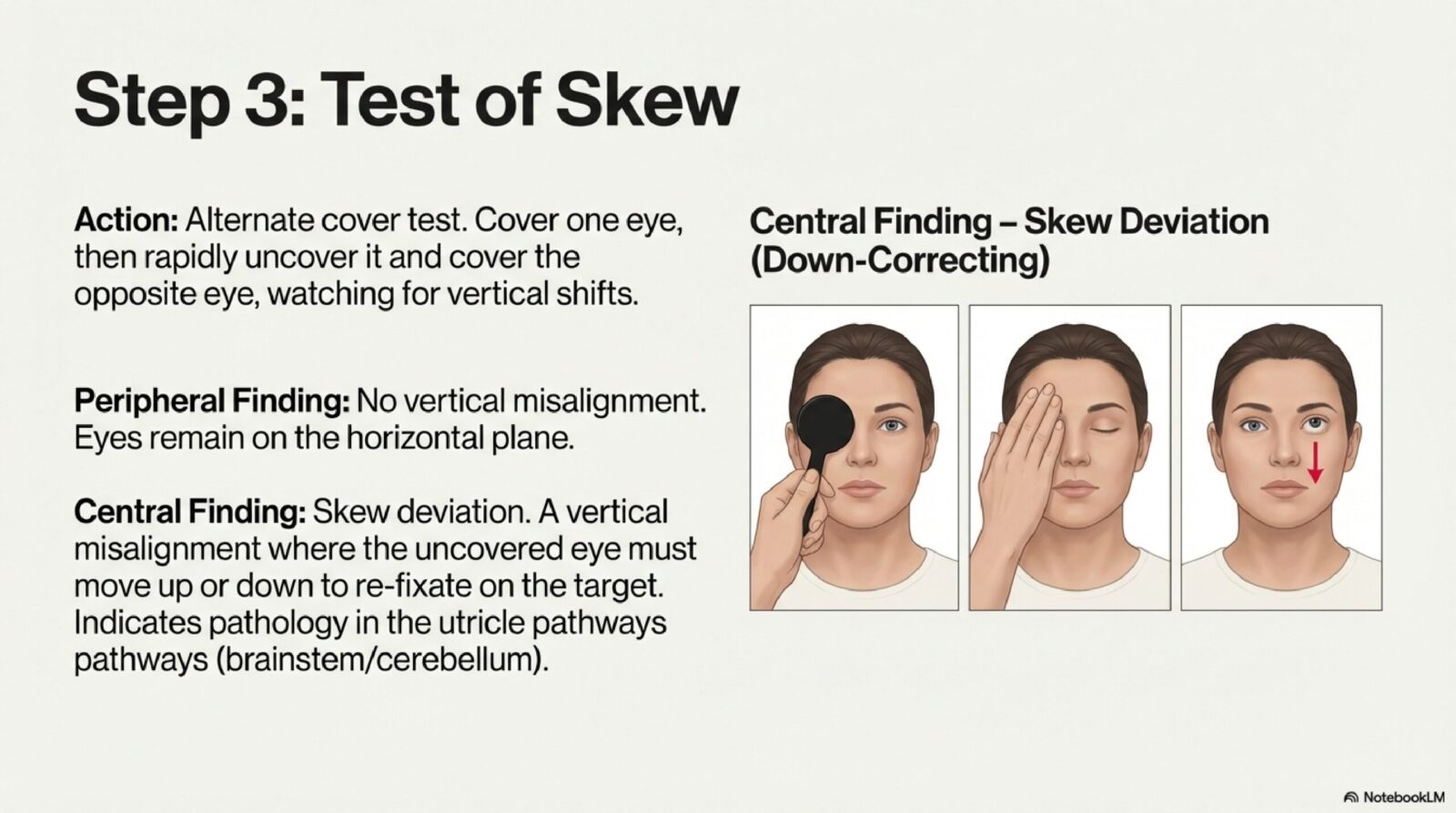
Skew deviation is a vertical misalignment of the eyes — one eye sits slightly higher than the other because of a problem in the balance pathways of the brainstem or cerebellum. Doctors check for it with a simple cover–uncover manoeuvre called the test of skew. It matters because, unlike most inner-ear (peripheral) vertigo, skew deviation is considered a central sign — when it appears alongside acute vertigo, it raises concern for a brain-related cause such as a stroke, which needs urgent evaluation. This is a clinician’s sign, not something to test at home, and any stroke-type warning signs are an emergency regardless. If you’re concerned, get assessed.
What is skew deviation?
It’s a vertical (up–down) misalignment of the eyes caused by disruption in the pathways that keep the eyes level. Patients may notice vertical double vision or tilting, though it can also be subtle and only found on examination.
How the test of skew is done
The clinician has you look straight ahead and covers one eye, then uncovers it, watching for a small vertical movement as the eye re-aligns. A vertical corrective movement suggests skew deviation.
Why it’s a “central” sign
Most sudden vertigo comes from the inner ear and is not dangerous. Skew deviation is different: it points toward the central balance pathways, so its presence shifts concern toward the brain rather than the ear.
Its role in the HINTS exam
Skew is the “S” in the three-part HINTS exam (Head Impulse, Nystagmus, Test of Skew). Within HINTS, a positive test of skew is one of the findings that can raise concern for a central cause — interpreted together with the other components, not alone.
What it can point to
Red flags — seek emergency care
Skew deviation is usually found by a clinician, but if vertigo comes with sudden vertical double vision, weakness or numbness, facial droop, slurred speech, severe headache, or trouble walking, treat it as an emergency.
Consult Dr. Prateek Porwal
For assessment of vertigo and appropriate testing, Dr. Prateek Porwal, ENT and vertigo specialist at Prime ENT Center, can help. 👉 Book an appointment or contact us on WhatsApp.
FAQ
What is skew deviation?
A vertical misalignment of the eyes caused by a problem in the brain’s balance pathways — a central sign.
Is skew deviation always serious?
It’s regarded as a central sign and warrants urgent assessment when it appears with acute vertigo.
How is the test of skew done?
By covering and uncovering one eye and watching for a small vertical re-alignment movement.
Which symptoms need emergency care?
Vertical double vision, weakness/numbness, facial droop, slurred speech, severe headache, or trouble walking.
This page is for patient education and does not replace a clinical consultation. For sudden weakness, speech trouble, double vision, severe new headache, fainting, chest pain, or sudden hearing loss, seek urgent medical care.
Why skew deviation matters in a vertigo assessment
Skew deviation matters because it is one of the eye findings that can point away from a simple inner-ear cause. Many common vertigo problems, such as BPPV, come from the vestibular system in the ear and are triggered by position. A skew finding is different: it suggests that the brain pathways coordinating both eyes may be involved. That does not mean a patient should diagnose stroke from one sign alone, but it does mean the finding deserves proper clinical assessment.
How it differs from ordinary dizziness
Patients rarely come saying, “I have skew deviation.” They usually report severe dizziness, imbalance, double vision, trouble walking, or a feeling that their eyes are not aligned. The doctor looks for skew as part of a broader eye-movement and neurological exam. The finding is interpreted together with nystagmus direction, head impulse testing, hearing symptoms, walking balance, blood pressure, stroke risk factors, and the exact timing of the dizziness.
When the test of skew is most useful
The test is most relevant in acute, continuous vertigo where the question is whether symptoms are coming from the inner ear or the central nervous system. It is not the usual test for brief spinning triggered by rolling in bed, which is more typical of BPPV and is assessed with the Dix-Hallpike test. This distinction is important because the correct pathway for testing and treatment changes with the pattern.
What to tell the doctor
- When the dizziness started and whether it is constant or position-triggered.
- Whether there is double vision, slurred speech, weakness, numbness, severe headache, or trouble walking.
- Whether hearing loss, tinnitus, ear fullness, migraine, blood pressure issues, diabetes, or new medicines are present.
- Whether this is the first episode or a repeated pattern.
For connected reading, see the HINTS exam guide, upbeat nystagmus, and central vertigo.
Read next — from Dr. Porwal's vertigo library