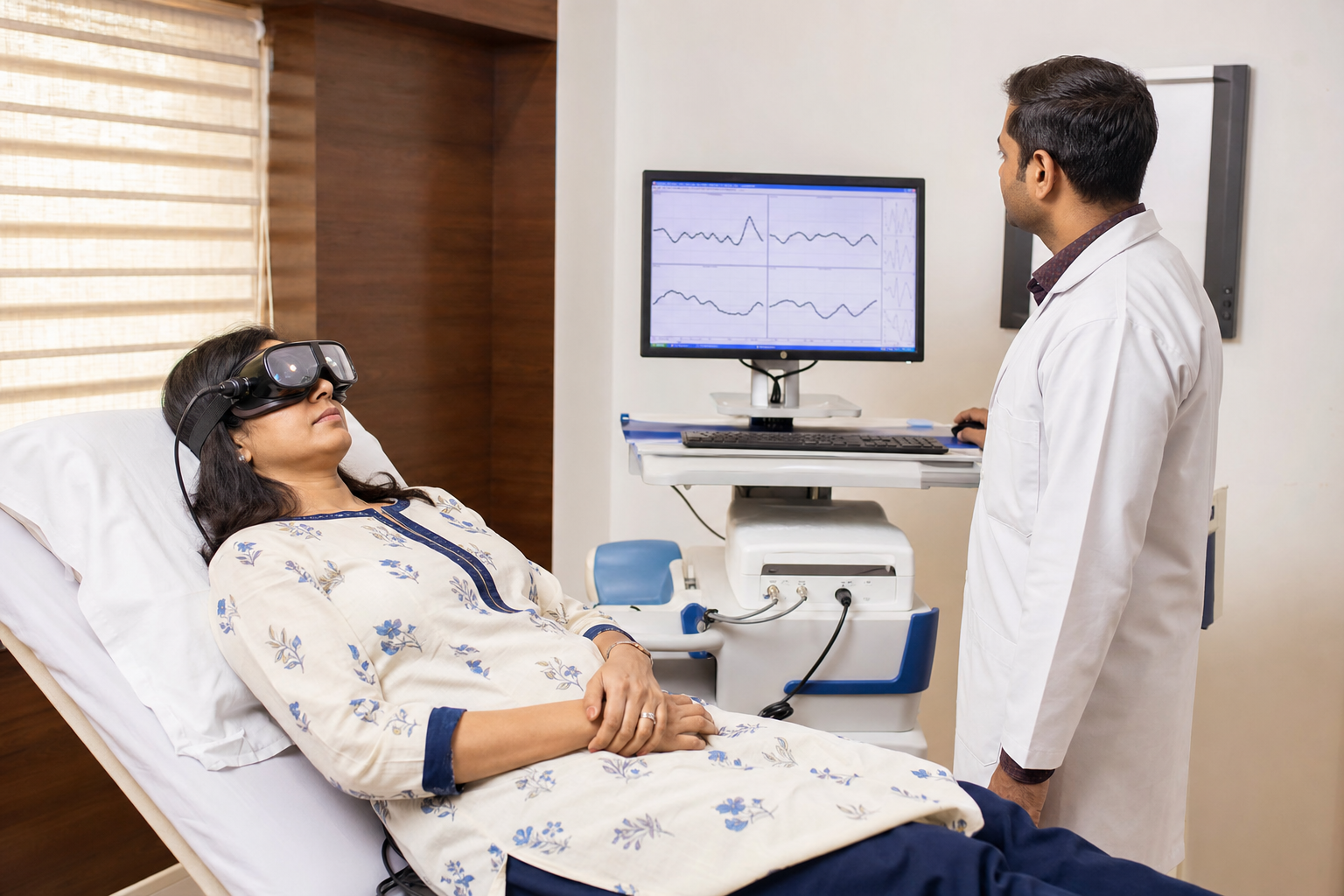
The caloric test checks how each horizontal balance canal responds at very low frequency. It is useful when patients have one-sided vestibular weakness, unclear VNG findings, or dizziness that needs more detail than bedside examination alone can provide.

It sounds strange. And honestly, if you don’t understand the physics behind it, it does feel arbitrary. But the caloric test is actually one of the oldest and most reliable VNG testing tests we have. Been around since the 1900s.

Let me explain why it works — and why I still use it, even though newer tests like vHIT exist.

The Physics of Temperature and Movement

Your semicircular canals are filled with fluid called endolymph. When you move your head, that fluid sloshes around, bending tiny hair cells (called cilia) inside the canals. Those bent hairs send signals to your brain about rotation and movement.

Now, here’s the trick: temperature also moves that fluid. Not through motion, but through physics.

When you put warm water near the ear canal, heat conducts through the thin canal wall to the fluid inside. Warm fluid is less dense than cool fluid. It rises. This creates a convection current — the fluid moves, even though there’s no physical head motion.

The moving fluid bends the same hair cells. Your brain thinks your head is moving. Your eyes respond.

When you put cool water in the same ear, cold fluid sinks. The current reverses. Your eyes respond in the opposite direction.

This is elegant. It’s a way to artificially stimulate the semicircular canals without actually rotating your head.

How I Do the Caloric Test

You sit in front of me in a dark room. The darkness is important — it makes the eye movements more obvious.

I look in your ear canal with an otoscope first. I’m checking for cerumen (earwax), infections, or perforation. If there’s any reason the ear canal isn’t intact, I can’t do the test.

Then I use warm water (usually around 44°C) and irrigation the ear canal for about 30 seconds. Controlled irrigation — not a harsh stream. Just enough to stimulate.

Your eyes start moving. We call this nystagmus. Your brain is reacting to the artificial signal that your head is moving.

I watch the eye movements. I record the direction, speed, and duration.

Then I wait about 5 minutes for the effect to wear off and your eyes to settle.

Then I do the cool water (usually around 24°C) in the same ear.

Your eyes move again, usually in the opposite direction.

Then I repeat the whole process in the other ear.

Total time: about 20-30 minutes. And yes, some patients feel a bit of vertigo or imbalance during the test. That’s normal. It goes away in minutes.

What I’m Looking For

I’m measuring something called the “caloric response” — basically, how much nystagmus (eye movement) each ear produces in response to temperature.

In a healthy person:
– Warm water in the left ear produces rightward nystagmus
– Cool water in the left ear produces leftward nystagmus
– Warm water in the right ear produces leftward nystagmus
– Cool water in the right ear produces rightward nystagmus

This pattern is consistent. Predictable.

The speed of that nystagmus is also important. A normal caloric response produces eye velocities of about 10-60 degrees per second. Too slow and there’s a problem. Too fast (well, “too fast” is rare, but it happens with central lesions sometimes).

Canal Paresis and Directional Preponderance

Two key findings on caloric test:

**Canal paresis:** One ear responds much less than the other. Like, left ear gives a strong response but right ear is barely responsive. This tells me: the right vestibular system is weak or damaged.

I see this commonly in patients with acute vestibular neuritis. One ear suddenly stops responding. The caloric test shows the dramatic asymmetry.

**Directional preponderance:** The eye movements in one direction are stronger than the other, regardless of which ear is stimulated. Like, all rightward movements are fast, all leftward movements are slow. This pattern can suggest central problems (like brainstem lesions) or bilateral dysfunction.

In my clinic, I track both. Canal paresis tells me which peripheral ear is bad. Directional preponderance makes me think about central problems and order an MRI.

Caloric Test in Acute Vertigo

When a patient comes in with sudden severe vertigo — woke up this morning and the room is spinning — the caloric test helps me understand the severity.

I saw a patient from Kannauj last year. Woke up with intense vertigo. Walking was impossible. I did caloric test: left ear completely unresponsive, right ear normal.

Diagnosis: acute vestibular neuritis of the left ear. The sudden, complete loss of response told me it was a recent, significant event.

I could say with confidence: “Your left vestibular nerve is inflamed and not working right now. But you’ll recover. Most people do in 4-8 weeks with rehab.”

The caloric test gave me that certainty.

Why Not Just Use vHIT?

vHIT is faster and more comfortable. I use it frequently. But here’s why I still do caloric tests:

1. **Lateral canal specificity.** Caloric test specifically stimulates the lateral semicircular canal. vHIT tests it too, but caloric is the gold standard for lateral canal VNG testing.

2. **Age considerations.** Some older patients have difficulty keeping their eyes fixed on a target (needed for vHIT). Caloric test doesn’t require that — they just sit and let their eyes move.

3. **Directional preponderance information.** vHIT doesn’t give me directional preponderance data. Caloric test does. That helps identify central problems.

4. **Historical continuity.** If a patient was tested 5 years ago with caloric test, and I want to compare progress, I use caloric again for consistency.

Why Water Temperature Matters

The temperature difference is important. The larger the difference between water and normal body temperature, the stronger the response.

Warm water (44°C) and cool water (24°C) gives about a 20-degree difference. That’s enough to create a reliable response without being too extreme.

If I used water that’s too cool (like room temperature), the response would be weak. If I used boiling water, I’d hurt the patient and get other problems.

The 44/24 setup is calibrated by decades of use. It’s the sweet spot.

Caloric Test and Central Vertigo

This is where caloric test shows its value for ruling things in or out.

Peripheral problems (like BPPV, vestibular neuritis, Meniere’s disease) usually show canal paresis — one ear weak, the other normal.

Central problems (like brainstem stroke, multiple sclerosis, cerebellar lesions) often show directional preponderance — the directional asymmetry without clear canal paresis.

If I see directional preponderance without canal paresis, I’m ordering an MRI. That pattern worries me.

Caloric Test and Compensated Patients

Here’s something interesting. Some patients have chronic unilateral vestibular loss — they’ve had a dead ear for months or years. Their brain has completely compensated.

On caloric test, that ear still doesn’t respond (it’s still dead). But because they’ve adapted, they don’t feel dizzy anymore. They function normally.

The caloric test shows the objective problem. But the clinical picture (they feel fine) shows their brain’s adaptation.

This is why I always say: test results matter, but how the patient feels matters more. Caloric test gives objective data. But it’s one piece of the puzzle.

Patient Experience and Tips

Yes, the water in the ear feels strange. Some patients feel mild dizziness or vertigo during the test. It’s temporary and normal.

I always warn patients beforehand: “You might feel the room spin a bit. It’s normal. It will pass in a minute.”

After the test, you should be fine within 5-10 minutes. No residual dizziness from the water itself.

Some patients ask: “Will this damage my balance?” No. The test stimulates your balance system, but it doesn’t damage it.

When Caloric Test Can’t Be Done

If you have a perforated eardrum, I can’t do caloric testing through the canal. The water might get into the middle ear, and that’s a risk.

Also, if you have cerumen impaction so bad that I can’t see the canal, I’ll clean it out first.

Infection of the ear canal (otitis externa) is a relative contraindication too — I’d wait until it clears.

The Ungainly Acronym: ENG

When I order “ENG caloric testing,” ENG stands for electronystagmography — fancy name for “recording eye movements electrically.”

Old school, we just watched the eyes move. Now, we have infrared cameras or electrodes that track movements precisely. Gives us numbers.

Those numbers are objective. Not dependent on my eyesight or interpretation. That’s progress.

FAQ

**Q: Is warm water the same as body temperature?**
A: No. Body temperature is 37°C. We use 44°C — warm, but not hot.

**Q: Can the water damage the eardrum?**
A: Not with proper technique. I use controlled irrigation. The eardrum is naturally perforation-resistant.

**Q: How long does the dizziness from caloric test last?**
A: Usually 1-2 minutes per ear stimulation. A few minutes tops. Gone by the time you leave the clinic.

**Q: If caloric test is normal, does that mean my balance is fine?**
A: Not necessarily. Caloric test only measures semicircular canal response. It doesn’t test the gravity sensors (saccule and utricle) or overall balance control. You might have a normal caloric test but abnormal VEMP or stabilometry.

**Q: Can I eat or drink before the test?**
A: Yes, caloric test doesn’t require fasting. Just avoid heavy meals right before if you’re prone to nausea.

**Q: What if I get water in my throat?**
A: It doesn’t happen with proper technique. The ear canal has a natural barrier. Water stays in the canal.

References

1. Jahn K, et al. “The Caloric Vestibular Test.” *Deutsches Ärzteblatt International*, 2008; 105(23):415-421.
2. Baloh RW. “Clinical Practice: Vestibular Neuritis.” *New England Journal of Medicine*, 2003; 348(11):1027-1034.
3. Furman JM, Cass SP. “Benign Paroxysmal Positional Vertigo.” *New England Journal of Medicine*, 1999; 341(21):1590-1596.

About the Author
Dr. Prateek Porwal is an ENT & Vertigo Specialist with over 13 years of experience, holding MBBS (GSVM Medical College), DNB ENT (Tata Main Hospital), and CAMVD (Yenepoya University). He is the originator of the Bangalore Maneuver for Anterior Canal BPPV and has published research in Frontiers in Neurology and IJOHNS. Serving at Prime ENT Center, Hardoi.

This article is for educational purposes. Please consult Dr. Prateek Porwal at Prime ENT Center, Hardoi for personal medical advice.

Related Reading

  • VNG testing
  • vHIT — the quick test that tells us which ear is the problem
  • VEMP Test, Measuring Otolith Function in Vertigo Patients
  • VEMP Test, Measuring Your Otolith Function
  • VEMP test — what it tells about your balance organs

Dr. Prateek Porwal is an ENT & Vertigo Specialist with over 13 years of experience, holding MBBS (GSVM Medical College), DNB ENT (Tata Main Hospital), and CAMVD (Yenepoya University). He is the originator of the Bangalore Maneuver for Anterior Canal BPPV and has published research in Frontiers in Neurology and IJOHNS. Serving at Prime ENT Center, Hardoi.

Reference: Persistent Postural-Perceptual Dizziness — Staab et al, 2017

Book a Consultation

Call or WhatsApp: 7393062200

Online consultations available across India.

Dr. Prateek Porwal

Dr. Prateek Porwal (MBBS, DNB ENT, CAMVD) is a vertigo and BPPV specialist at Prime ENT Center, Nagheta Road, Hardoi, UP 241001. Inventor of the Bangalore Maneuver. Only VNG + Stabilometry setup in Central UP. Online consultations available across India — call/WhatsApp 7393062200.