In my practice at Prime ENT Center in Hardoi, I see many BPPV cases-mostly posterior canal (85-90%), occasionally horizontal (10-15%). But anterior canal BPPV? That’s the rare bird. Only 1-2% of BPPV cases involve the anterior (or superior) semicircular canal. When I encounter it, I know I’m dealing with something diagnostically tricky and often mismanaged.

What makes anterior canal BPPV particularly challenging is that it’s frequently misdiagnosed. Patients get sent for expensive MRI scans for central causes when the problem is actually mechanical and treatable in my clinic. That’s why I want to explain this condition clearly.

What is Anterior Canal BPPV?

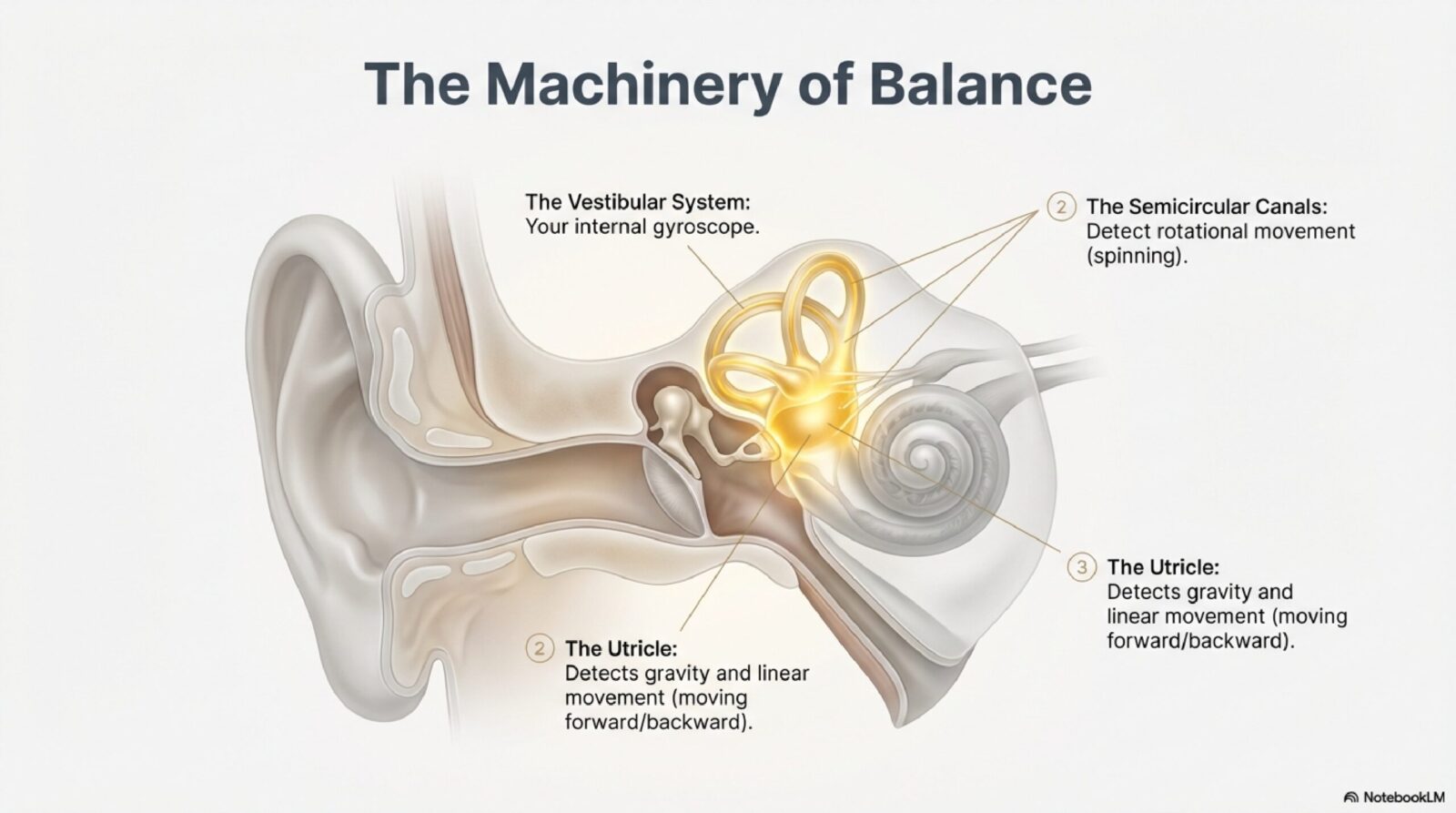
Like all BPPV, anterior canal BPPV occurs when loose otoconia (calcium carbonate crystals) end up in the anterior semicircular canal. Your anterior canal is the vertically-oriented canal that points forward and upward inside your ear.

Diagram of the three semicircular canals of the inner ear — posterior, anterior, and lateral — showi

The anterior canal is unusual compared to the posterior and horizontal canals. It has a different anatomy-higher threshold for crystal movement, different sensory sensitivity. When crystals do get into the anterior canal, it causes a particular pattern that confuses many doctors.

The challenge is that anterior canal BPPV is so rare, and the eye movement pattern it produces can look like it’s coming from the brain rather than the ear. This leads to unnecessary brain imaging and patient anxiety.

Why Anterior Canal BPPV is So Rare

The precise reason anterior canal BPPV is uncommon isn’t fully understood. Anatomically, the anterior canal is positioned differently-more vertical and higher within the ear. Perhaps its orientation makes it less likely for crystals to naturally fall into it. Or perhaps when crystals do enter, they’re more likely to fall back out.

Whatever the reason, anterior canal BPPV is genuinely uncommon. In my practice of hundreds of BPPV patients, I diagnose it only occasionally. But each time I do, I’m grateful for the specific diagnostic clues that help me identify it.

Classic Symptoms of Anterior Canal BPPV

Anterior canal BPPV presents with symptoms that can confuse patients and doctors alike:

Patients often describe feeling worse when looking down. Some tell me, “Doctor, I can’t look at my phone,” or “Bending to pick things up makes me dizzy.”

The Diagnostic Clue: Downbeat Nystagmus on Dix-Hallpike

Here’s what makes anterior canal BPPV diagnostically distinctive and also confusing. When I perform the Dix-Hallpike test (which I still do to look for the pattern), something unusual happens in anterior canal BPPV.

Remember in typical posterior canal BPPV, the nystagmus beats upward (upbeating). In anterior canal BPPV, I see downbeat nystagmus-the eyes jerk downward. This is the opposite of what I expect with posterior canal involvement.

Downbeat nystagmus is a big warning sign in neurology. It’s classically associated with central nervous system problems like cerebellar degeneration, multiple sclerosis, or Arnold-Chiari malformation. So when a primary care doctor hears about downbeat nystagmus, they think “brain problem” and order an MRI.

That’s the trap. Downbeat nystagmus can absolutely be from anterior canal BPPV-a completely benign, mechanical problem in the ear. But its appearance triggers concern about central causes.

👉 Also read: Why Does BPPV Keep Coming Back? Understanding Recurrence

How to Distinguish Anterior BPPV from Central Causes

This is critical because missing a central cause would be dangerous, but over-investigating benign BPPV with unnecessary imaging wastes time and money and frightens patients.

Here’s how I differentiate anterior canal BPPV from true central positional nystagmus:

Characteristics of anterior canal BPPV:

Red flags for central causes:

The latency and fatigability are your friends in diagnosis. If the downbeat nystagmus has latency and fatigability, it’s almost certainly BPPV. If it’s immediate and persistent, think central.

Treatment Options: Kim Maneuver and Reverse Epley

Before I discuss my Bangalore Maneuver, let me mention the established treatments for anterior canal BPPV.

The Kim Maneuver (also called Deep Head Hanging): Dr. Seok-Min Kim described a specific repositioning maneuver for anterior canal BPPV. It involves positioning the patient supine with the head hanging off the edge of the table, then rolling the head to one side, then to the other, in a way that guides crystals out of the anterior canal. Success

Reverse Epley Maneuver: Some clinicians modify the standard Epley maneuver by reversing the direction of movements. Instead of the typical head-back position, we start head-down position and reverse the rotation. This can work for some anterior canal cases.

Both approaches aim to dislodge crystals from the anterior canal and guide them back to the utricle.

The Bangalore Maneuver: My Proprietary Technique

Several years ago, I encountered repeated cases of anterior canal BPPV that were either misdiagnosed or resistant to standard maneuvers. I was frustrated by patients being sent for unnecessary MRIs, and I was seeing that even when anterior BPPV was correctly identified, success rates with existing maneuvers weren’t best.

Working in Bangalore at a vestibular conference, I began thinking about the unique mechanics of anterior canal involvement. The anterior canal’s orientation-pointing upward and forward-means that gravity and head position work differently compared to the posterior canal. I realized that to truly guide crystals out of the anterior canal, I needed to account for this different geometry.

I developed what I now call the Bangalore Maneuver based on these principles:

Why I developed it: Existing maneuvers were designed primarily for posterior canal BPPV. While they can work for anterior canal, they’re not optimized for its unique canal orientation. I wanted a technique that specifically addressed anterior canal mechanics.

👉 Also read: Posterior Canal BPPV, Complete Treatment Guide

How the Bangalore Maneuver works:

The maneuver involves a specific sequence of head positioning that uses gravity and momentum to guide crystals along the anterior canal’s particular path. Unlike the Epley (which works great for posterior), this maneuver accounts for the anterior canal’s forward and upward tilt.

Step 1: Patient starts seated upright. I identify which anterior canal is affected (left or right) based on the nystagmus direction.

Step 2: I have the patient look forward and slightly upward at a specific angle. This positions the anterior canal ideally for crystal movement.

Step 3: The patient performs a rapid forward-and-down movement with head flexion, while I provide gentle guidance and slight rotation.

Step 4: The sequence guides crystals gradually toward the exit point of the anterior canal back into the utricle.

Step 5: We maintain the final position for 30-45 seconds.

The entire maneuver takes about 5-8 minutes.

Why it works better for anterior canal: The Bangalore Maneuver specifically accounts for the anterior canal’s orientation. By using a forward-flexion component and precise angle positioning, we optimize the gravitational path that crystals must follow. This is more effective than trying to force anterior canal crystals to follow a path designed for posterior canals.

👉 Also read: Recurrent BPPV: Why It Keeps Coming Back

Success rates in my practice: In my Hardoi clinic, I’ve found the Bangalore Maneuver to be effective in about 85-90% of true anterior canal BPPV cases on the first treatment. This compares favorably to the 60-80% success rates reported with other anterior canal maneuvers.

I’ve now taught this technique to other vestibular specialists, and I’m working on publishing the results formally. The positive response from colleagues has been gratifying.

Real Case: Anterior BPPV Misdiagnosed as Central Cause

Miss Sharma, 35 years old, came to me after a visit to a major hospital. She’d been experiencing vertigo for two weeks, especially when looking down or bending forward. The hospital physician found downbeat nystagmus on examination and ordered an MRI “to rule out MS or cerebellar disease.”

The MRI was normal, but she was terrified. She thought something was seriously wrong with her brain.

👉 Also read: Cervicogenic Vs Bppv Difference

When she came to my clinic, I did a careful Dix-Hallpike test. Yes, downbeat nystagmus appeared. But it had latency-about 3 seconds-and it fatigued. The characteristics screamed BPPV, not central disease.

I explained that her downbeat nystagmus was from mechanical crystals in her anterior canal, not her brain. She looked relieved. I performed the Bangalore Maneuver.

After the maneuver, her vertigo improved significantly. She came for follow-up after a week, and she’d had no recurrence. “Doctor, I was so scared. Thank you for explaining this properly and fixing it so easily.”

When Anterior BPPV Might Actually Be Central

I must emphasize: not all downbeat nystagmus is BPPV. If I see any of these red flags, I don’t jump to treating BPPV. I get imaging:

I’d rather be cautious and image someone with atypical features than miss a serious central cause. But in my experience, when the clinical picture is typical for anterior BPPV-positional trigger, latency, fatigability, no other neurologic findings-it’s BPPV.

FAQ Section

Q: Is anterior canal BPPV dangerous?

No more dangerous than posterior or horizontal BPPV. It’s mechanical and benign. The danger isn’t the BPPV itself, but the risk of unnecessary testing if it’s misdiagnosed as a central cause. That’s why proper diagnosis matters.

Q: If I have downbeat nystagmus, do I need an MRI?

Not automatically. If the downbeat nystagmus has latency and fatigability, and it’s triggered by specific head positions, and you have no other neurologic symptoms, anterior BPPV is the likely diagnosis and MRI isn’t needed. But if any red flags are present, imaging is warranted.

Q: What is the Bangalore Maneuver?

It’s a repositioning technique I developed specifically for anterior canal BPPV. It accounts for the anterior canal’s unique orientation and is more effective than trying to use posterior canal maneuvers for anterior involvement. About 85-90% of my anterior BPPV patients are better after one Bangalore Maneuver treatment.

Q: Can the Bangalore Maneuver hurt me?

No, it’s a safe maneuver when performed by someone trained. The only discomfort is the vertigo sensation during the maneuver, which is temporary.

Q: How is anterior canal BPPV triggered?

Typically by forward bending, tucking the chin to the chest, or looking down. These movements position the anterior canal such that loose crystals move within it and cause vertigo.

Q: Can anterior canal BPPV cause constant dizziness?

Yes, unlike posterior canal BPPV which causes brief attacks, some anterior canal cases have more persistent symptoms. This is another reason it’s sometimes confused with central causes, which also tend to cause continuous symptoms.

👉 Also read: BPPV ಎಂದರೇನು? ಕಿವಿಯೊಳಗಿನ ಕಲ್ಲುಗಳಿಂದ ತಲೆ ತಿರುಗುವಿಕೆ

Final Thoughts

Anterior canal BPPV is rare, but when it occurs, proper diagnosis is essential. The good news is it responds well to specific treatment. The bad news is it’s often misdiagnosed, leading to unnecessary brain imaging and patient anxiety.

If you experience vertigo triggered by forward bending or looking down, and you’ve been told your downbeat nystagmus needs an MRI “to rule out serious causes,” get a vestibular specialist’s opinion before you panic. It might simply be anterior canal BPPV, which is highly treatable.

About Dr. Prateek Porwal

Dr. Prateek Porwal is an MBBS, DNB ENT specialist and Senior Consultant ENT Surgeon at Prime ENT Center, Hardoi, UP. He is recognized for his expertise in diagnosing and treating all types of BPPV, particularly the challenging anterior canal variant. Dr. Porwal developed the Bangalore Maneuver, a proprietary technique for anterior canal BPPV that has achieved superior success rates compared to traditional methods. He was honored with the VAI Budapest 2025 award for his significant contributions to vestibular science and clinical innovation. Dr. Porwal is committed to bringing specialized vestibular care and evidence-based treatment to patients throughout Uttar Pradesh.

Book your appointment today: Call 7393062200 or WhatsApp https://wa.me/917393062200

Prime ENT Center, Hardoi, UP | Website: drprateekporwal.com

Frequently Asked Questions

How is anterior canal BPPV different from posterior canal BPPV?

The difference lies in which semicircular canal is affected. The semicircular canals are three fluid-filled tubes in your inner ear that detect head movement. The posterior canal is the most common location for loose crystals, causing posterior canal BPPV. The anterior canal is at the front, and anterior canal BPPV is less common, accounting for about 10% to 15% of all BPPV cases. The differences matter clinically: posterior BPPV causes vertigo when you tilt your head backward or lie flat on your back. Anterior BPPV causes vertigo with forward head tilt or lying face-down movements. The tests I perform are different, and the treatment maneuvers are different too. A patient who had the wrong maneuver done somewhere else might seem treatment-resistant until we get the correct diagnosis.

What causes anterior canal BPPV?

Anterior canal BPPV happens for the same fundamental reason as posterior canal BPPV: loose calcium carbonate crystals in your inner ear that have dislodged from their normal position. The crystals float around in the fluid within the semicircular canals, and when you move your head, they move, triggering false signals to your brain about head position. This causes vertigo. What causes the crystals to loosen in the first place? Common triggers include head trauma, prolonged bed rest, inner ear infections, osteoporosis, or sometimes it happens spontaneously with no clear cause. In my Lucknow clinic, I see anterior canal BPPV most often in patients over 50 and in those with prior head injuries. A 58-year-old patient came in after a minor fall at home, the head impact was relatively minor, but it dislodged crystals in his anterior canal. I treated him, and he recovered completely.

Which maneuver treats anterior canal BPPV specifically?

The Bangalore Maneuver and the Yacovino Maneuver are the two main techniques for anterior canal BPPV. The Bangalore Maneuver, which I use frequently, involves specific head and body rotations designed to move crystals out of the anterior canal. The Yacovino Maneuver is another option with similar effectiveness. The key is that the standard Epley Maneuver, which works beautifully for posterior canal BPPV, is not effective for anterior canal cases. If someone gives you an Epley maneuver when you actually have anterior canal involvement, you will likely not improve. This is why accurate diagnosis before treatment is so important. In my clinic, I perform diagnostic positioning tests that specifically identify which canal is affected, then choose the appropriate maneuver.

How rare is anterior canal BPPV really?

Anterior canal BPPV is significantly less common than posterior canal BPPV. In my clinical experience, approximately 85% of my BPPV patients have posterior canal involvement, 10% have anterior canal, and 5% have horizontal canal or mixed involvement. This rarity is partly why it is often misdiagnosed or missed altogether. Many general practitioners and even some ENT doctors see it so rarely that they might not think of it when a patient presents with specific vertigo symptoms. In larger cities with more volume, specialists like myself see anterior canal cases regularly enough to recognize them. If you have been treated for BPPV without improvement, anterior canal involvement should be considered as one possibility.

Can anterior canal BPPV be confused with something more serious?

Yes, it can be confused with other conditions, which is exactly why I always perform a thorough evaluation before diagnosing BPPV. Anterior canal BPPV can sometimes seem like a stroke, a neurological problem, or a serious inner ear infection because the vertigo can be quite intense. A 62-year-old patient came to me from another city where she had been sent for an MRI brain because doctors were worried her anterior canal BPPV might be a stroke symptom. After proper examination, the diagnosis was clear: benign paroxysmal positional vertigo, completely treatable. However, I do not want to minimize it either, if you have sudden onset vertigo with other symptoms like weakness, numbness, difficulty speaking, or visual changes, you should be evaluated urgently to rule out serious problems first. Once serious conditions are excluded, we can confidently diagnose and treat BPPV.

How many treatment sessions are typically needed for anterior canal BPPV?

Most patients need one to two sessions. In my experience, about 75% of anterior canal BPPV patients resolve completely with one maneuver. Another 20% need a second session, usually within a week of the first. The remaining small percentage might need three sessions or have additional factors complicating recovery. After the maneuver, I always recommend vestibular exercises and sometimes rehabilitation therapy at home. The total treatment period from first visit to complete resolution is typically 2 to 4 weeks. It is faster than some conditions but slower than a simple medication course, which is why patient understanding and compliance matter.

Can anterior canal BPPV recur after successful treatment?

Yes, it can recur, though recurrence rates are lower with anterior canal BPPV than with posterior canal BPPV. In posterior cases, I see recurrence in about 20% to 30% of patients. With anterior canal, it is closer to 10% to 15%. Why the difference? I am honestly not entirely certain from a mechanistic standpoint, but it might relate to anatomy or how gravity affects crystal movement differently in the anterior canal. If BPPV does recur, the good news is that patients who have had it treated before recover faster because they know what to expect and seek treatment promptly. Doing vestibular exercises regularly and maintaining good neck mobility seem to reduce recurrence risk. I advise patients with a history of anterior canal BPPV to continue gentle vestibular exercises once or twice weekly indefinitely.

How can I confirm I have anterior canal BPPV and get treated by a specialist?

You need to see a doctor trained in vestibular diagnosis. Not every clinic is equipped to diagnose anterior canal BPPV accurately. The diagnosis involves positional testing, I position your head in specific ways and observe your eye movements and vertigo response, then determine which canal is affected. Standard diagnostic tests alone will not always differentiate anterior from posterior canal involvement. You can contact me at 7393062200 or visit drprateekporwal.com to book a consultation. I am at Prime ENT Center in Lucknow, and I evaluate and treat anterior canal BPPV cases regularly. During your appointment, I will perform the necessary tests, explain what is happening, and if anterior canal BPPV is confirmed, I will perform the appropriate maneuver right then. You do not need expensive imaging; clinical examination is sufficient for diagnosis and treatment.


Medical Disclaimer: This article is for educational purposes only and does not constitute medical advice, diagnosis or prescribing guidance. Consult Dr. Prateek Porwal at Prime ENT Center, Hardoi for personalised treatment.

References

  1. Bhattacharyya N, et al. Clinical Practice Guideline: Benign Paroxysmal Positional Vertigo (Update). Otolaryngology–Head and Neck Surgery. 2017;156(3_suppl):S1–S47.
  2. von Brevern M, et al. Epidemiology of benign paroxysmal positional vertigo: A population based study. Journal of Neurology, Neurosurgery, and Psychiatry. 2007;78(7):710–715.
  3. Epley JM. The canalith repositioning procedure: For treatment of benign paroxysmal positional vertigo. Otolaryngology–Head and Neck Surgery. 1992;107(3):399–404.

Leave a Reply

Your email address will not be published. Required fields are marked *