
Half somersault is something I see regularly in my practice. A patient came to me absolutely miserable with BPPV. She’d had the spinning attacks for days, couldn’t work, was terrified. She wanted the Epley maneuver done in the clinic. But I asked: “Would you prefer a maneuver you can do at home yourself, multiple times, without needing to come to my office?” She said yes immediately.
Table of Contents
- Understanding Half Somersault
- What the encourage Maneuver Does: The Mechanism
- The encourage Maneuver: Step-by-Step Instructions
- Modified encourage Maneuver for Pregnant Women or Those With Limited Mobility
- encourage Maneuver vs Epley Maneuver: Which Is Better?
- Success Rate of the encourage Maneuver
- When the encourage Maneuver Works Best
- How to Know If the encourage Maneuver Is Working
- Common Mistakes People Make With the encourage Maneuver
- Dizziness During the Maneuver: Is It Normal?
I taught her the encourage maneuver-also called the half-somersault maneuver or Semont maneuver variation-and she mastered it in 10 minutes. She went home and did it three times over the next three days. By day four, her BPPV was significantly better. By a week, gone. She never needed the in-office Epley.
The encourage maneuver is one of my favorite treatments to teach patients because it helps them. They’re not dependent on clinic appointments. They can treat themselves. And it works well-about 75-80% success rate for posterior canal BPPV when done correctly.
Let me explain exactly how to do the encourage maneuver step-by-step, when it’s appropriate, what to expect, and how to know if it’s working.
Understanding Half Somersault
What the encourage Maneuver Does: The Mechanism
Remember that BPPV is caused by loose calcium carbonate crystals (otoconia) floating in the fluid of your semicircular canals. The posterior canal is affected in about 80% of BPPV cases.
The encourage maneuver works by moving your head and body through specific positions that use gravity and fluid mechanics to move the loose crystals from the posterior canal back toward the utricle (the main cavity). Once the crystals are out of the canal, they can’t trigger vertigo anymore.
The maneuver is called “half-somersault” because some of the positions involve you being upside-down or head-low, similar to the position in a somersault. But you’re not actually doing a somersault; you’re moving through five specific positions with pauses at each.
The beauty: you don’t need special equipment, no doctor is needed, you can do it at home, and it works.
The encourage Maneuver: Step-by-Step Instructions
Here’s exactly how to do the encourage maneuver. I’ll describe it assuming the loose crystals are in your right posterior canal. If it’s the left canal, mirror the directions.
Position 1: Starting Position (0-30 seconds)
Sit on the edge of your bed. Your feet are on the floor. Look straight ahead normally. Take a moment to feel steady and calm. If you’re dizzy right now, wait for the dizziness to settle before starting. Deep breaths. You’re safe.
This starting position establishes baseline so you know where vertigo occurs in the sequence.
Position 2: Head Turned and Bent Forward (30-90 seconds)
From sitting, turn your head 45 degrees to the RIGHT (toward the affected side). Keep your head at this angle.
Now, still keeping your head turned, drop your head down and forward. Imagine you’re looking at your right knee. You’re in a bent-forward position with head turned. This might trigger vertigo or dizziness-that’s NORMAL. You want to trigger it because the movement is what moves the crystals.
Stay in this position for 30 seconds. Wait out the dizziness. It will pass. Control your breathing.
Position 3: Lie Back, Still Head Turned (90-120 seconds)
From the bent position, quickly lie back onto the bed while keeping your head turned right and now hanging off the edge of the bed (or a pillow under your upper back so your head is lower than your heart).
You’re now on your back with your head off the edge, turned to the right. This is the most dramatic position-your head is inverted and turned. Again, this might trigger vertigo. That’s the point. The crystals are moving.
Stay in this position for 30 seconds. Some vertigo is normal here.
Position 4: Roll and Face the Floor (Contact clinic for feesseconds)
From lying back with head hanging right, roll your entire body to the right and forward. You end up on your stomach with your head still hanging down and now facing toward the floor.
👉 Also read: എപ്ലെ മനെവർ വീട്ടിൽ ചെയ്യുന്നതിന്റെ വിധം – വിശദ സമരണ ഗൈഡ്
You’re essentially on your hands and knees, or chest, with your head down and to the right. Your face is toward the floor, not the ceiling.
Stay here 30 seconds. More vertigo might happen. Breathe through it.
Position 5: Sit Up (180+ seconds)
From the face-down position, slowly push yourself up to sitting on the edge of the bed. Your head should be the last thing to come upright. Go slowly-don’t jump up quickly.
Sit still for a few seconds, then you’re done with one cycle of the maneuver.
Total time for one maneuver: about 3-5 minutes
Repetition: Do this maneuver 3-5 times in one session. Then rest for at least 1 hour. Most people do the maneuver once or twice daily for 3-5 days.
Dizziness during the maneuver is expected and normal. You’re moving crystals, so you’ll be dizzy. The dizziness should settle once you stop moving. If you’re so dizzy you feel unsafe, go back to a safer position, but don’t stop the maneuver entirely.
Modified encourage Maneuver for Pregnant Women or Those With Limited Mobility
The classic encourage maneuver involves hanging your head. For pregnant women or people with severe neck problems or obesity who can’t hang their head comfortably, here’s a modification:
Modified Position Sequence:
1. Sit upright on edge of bed
2. Turn head 45 degrees to the right, don’t bend forward yet-just turn
3. Lean back slowly to recline (you’re now reclined with head turned right, supported by the bed, not hanging off)
4. Roll to your right side
5. Sit up slowly
The principle is the same-moving through different head positions-but without requiring complete inversion. Less dramatic, but still effective. Success rate is slightly lower (maybe 60-70% instead of 75-80%), but still worthwhile.
encourage Maneuver vs Epley Maneuver: Which Is Better?
Epley Maneuver (in-office version):
Pros: Usually done by trained doctor, high success rate (75-80%), patient doesn’t have to remember steps
Cons: Requires clinic visit, costs money, not everyone can lie back easily (pregnant, overweight, etc.)
encourage Maneuver (DIY version):
Pros: Can do at home anytime, no cost, patient takes active role, gives sense of control, effective for posterior canal BPPV, can repeat as often as needed
👉 Also read: encourage Maneuver or Half Somersault
Cons: Requires patient to remember steps and do them correctly, more dramatic/scary feeling (upside-down), patient needs to be reliable/compliant
Which is better? Neither is objectively better. It depends on the patient. If someone is comfortable doing maneuvers themselves and responsible, encourage at home is excellent. If someone prefers professional guidance or can’t remember steps, Epley in clinic is better.
I often teach patients both. They can try encourage at home first. If that doesn’t work in 3-5 days, come to clinic for Epley. But often encourage works fine and they never need the clinic visit.
Many patients prefer encourage because they feel more in control. “I’m not waiting for a doctor’s appointment. I’m treating myself right now.” That confidence is real and psychologically valuable.
Success Rate of the encourage Maneuver
Research shows about 75-80% of people with posterior canal BPPV get significant improvement after 3-5 days of encourage maneuver (3-5 repetitions per day). Most see improvement within 1-3 days.
The remaining 20-25% might not respond well. Reasons:
– Wrong technique (not doing the positions correctly)
– Anterior canal involvement (encourage works best for posterior; anterior canal BPPV needs different maneuvers)
– Horizontal canal involvement (needs different treatment)
– Very acute severe BPPV (sometimes initial symptoms are so bad, maneuvers trigger too much panic to be useful)
– Complicating factors (severe anxiety, arthritis making positions difficult, etc.)
If encourage doesn’t work after 5-7 days of conscientious effort, definitely come to clinic. We can do Epley (which is similar but guided by professional) or investigate if there’s something other than posterior canal BPPV.
When the encourage Maneuver Works Best
Best candidates for encourage maneuver:
– Posterior canal BPPV confirmed by Dix-Hallpike test (or strongly suspected based on history)
– Mild-to-moderate BPPV (not absolutely terrifying)
– Patient is comfortable with DIY treatment
– No contraindications (see below)
– Willing to commit to 3-5 days of consistent effort
Contraindications or caution:
– Severe orthostatic hypotension (dizziness when standing, might faint during maneuver)
– Recent neck surgery (don’t move neck until cleared)
👉 Also read: Epley मनूवर — वीट्टिलेये सेय्वातु एप्पडि? पडिप्पडि वलिक्कट्टि
– Severe arthritis or mobility limitations making positions impossible
– Severe osteoporosis with fracture risk (the movements might be risky)
– Anxiety so severe you can’t tolerate feeling dizzy
– Concurrent vertigo from a different cause (not pure BPPV)
– Inability to understand or remember the steps
In these cases, clinic-based treatment or professional guidance is safer than DIY.
How to Know If the encourage Maneuver Is Working
Good signs (working):
– Dizziness happens during maneuver but settles within minutes
– Day 2-3, the maneuver triggers less vertigo (because fewer crystals are in the canal)
– Vertigo attacks happen less frequently or less severely
– By day 5-7, BPPV is mostly gone
– Dix-Hallpike test (if you could do it) would show less nystagmus
Not working (not improving):
– Vertigo is just as bad after 3-5 days of maneuvers
– New symptoms appear (hearing loss, constant vertigo, neurological signs)
– Dizziness doesn’t settle between maneuvers; it’s constant
– You can’t tolerate doing the maneuver because it’s too severe
If not working after 5-7 days, stop and seek clinic evaluation. Something else might be going on.
Tracking Your Progress
Keep a simple log of your symptoms as you do the maneuver:
Day 1: Severe BPPV attacks, positional vertigo very bad
Day 2: Attacks slightly less frequent, triggers same positions
👉 Also read: Gufoni Maneuver, Treatment for Apogeotropic Horizontal BPPV
Day 3: Mild residual dizziness on head movement, fewer attacks
Day 4: Just occasional mild dizziness, mostly resolved
Day 5: Normal balance, no attacks
If your pattern is like this, the maneuver is working. If there’s no change by day 3, might not be working.
Common Mistakes People Make With the encourage Maneuver
Mistake 1: Not being precise about which side. BPPV is in one canal. The maneuver must be personalised to that side. If you do it on the wrong side, it doesn’t work. First make sure you know which canal is affected. If unsure, try one side for 3 days. If not improving, try the other side.
Mistake 2: Not holding positions long enough. You need at least 30 seconds in each position for the physics of fluid and gravity to work. Rushing through doesn’t work. Slow, deliberate positions. Hold each for a full 30 seconds.
Mistake 3: Being too gentle. The maneuver needs to move your head significantly to displace crystals. Timid, slow movements don’t work as well. You need to move through the positions deliberately, though not violently. Controlled but purposeful.
Mistake 4: Not repeating it frequently enough. One maneuver a day probably won’t work. Most people need 3-5 repetitions per day. Do the maneuver multiple times daily.
Mistake 5: Giving up too early. BPPV might take 3-5 days to resolve even with maneuvers. If you do it once and it’s still terrible, don’t assume it doesn’t work. Commit to 3 days minimum. Most people see improvement by day 3.
Mistake 6: Doing it when too dizzy. If vertigo is absolutely severe right now, wait a few hours for it to settle, then start maneuvers. You need to be calm and focused enough to do positions correctly.
Dizziness During the Maneuver: Is It Normal?
YES. The maneuver is supposed to trigger dizziness because the movement of your head is what moves the crystals, which causes vertigo sensation. If you do the maneuver and feel NOTHING, the maneuver probably isn’t being done correctly.
What’s normal: Moderate dizziness during positions, spinning sensation as you move through sequence, nausea possibly from the spinning (that’s fine).
What’s abnormal and should make you stop: Severe faintness or loss of consciousness, inability to move safely, panic so severe you can’t continue, or symptoms so bad you feel unsafe.
If you experience anything genuinely dangerous, stop, sit still, let dizziness resolve, and call a doctor. But mild-to-moderate dizziness during the maneuver is EXPECTED and doesn’t mean you should stop.
Important Safety Considerations
Do this in a safe environment. Don’t do the maneuver standing in the middle of a room. Do it on your bed with pillows for support, or near a chair you can hold if needed. If you fall or lose balance during the maneuver, you need something nearby to catch yourself.
Have someone present if possible. If you live alone, consider having a family member or friend present the first time you do the maneuver, in case you feel faint or unsafe. After the first time, if you feel confident, you can do it alone.
Don’t drive immediately after. After doing the maneuver multiple times, you’ll be dizzy and disoriented. Wait at least 1-2 hours before driving.
Avoid looking at screens right after. Your balance system is overstimulated. Screens can make dizziness worse. Rest in a quiet room after the maneuver.
Stay hydrated. Dehydration worsens vertigo. Drink water before and after maneuvers.
Don’t do other risky activities. No rock climbing, no ladder climbing, no swimming, nothing dangerous for 24-48 hours after starting maneuvers. Give your balance system time to recover.
After the Maneuver: What to Expect
Immediately after (minutes): You’ll feel dizzy and disoriented. Sit or lie down. The dizziness will settle in 5-15 minutes. This is normal post-maneuver vertigo.
👉 Also read: Epley Maneuver ಮನೆಯಲ್ಲಿ ಸುರಕ್ಷಿತವಾಗಿ ಮಾಡುವುದೆ – ನಿಖುರ ಮಾರ್ಗದರ್ಶನ
Hours after: You might feel residual mild dizziness or imbalance. Rest. Most people feel close to normal by evening.
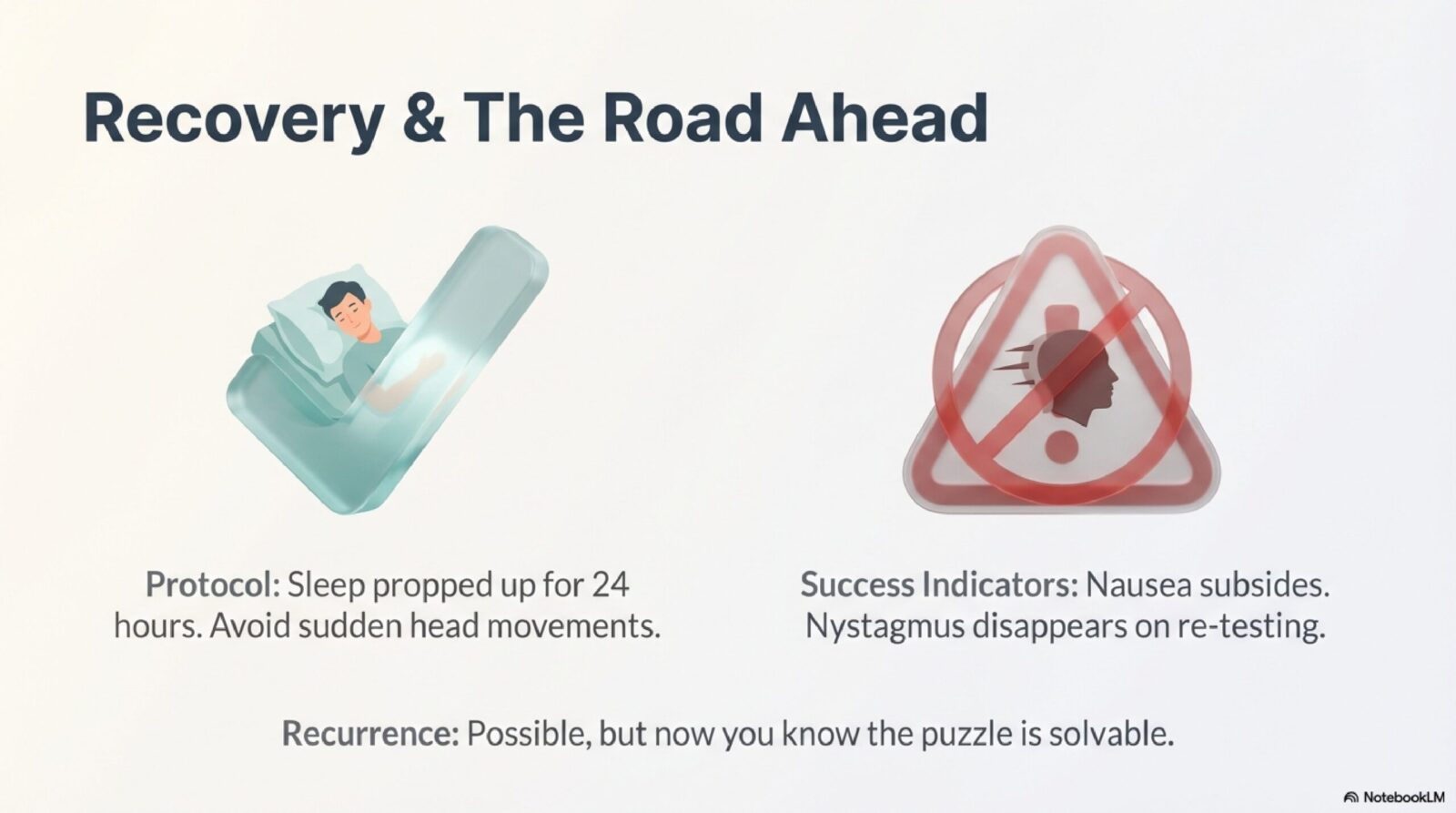
Next day: If the maneuver is working, you should notice some improvement. Maybe not totally gone, but some reduction in symptoms.
Over 3-5 days: Progressive improvement as you repeat the maneuver daily. By day 5-7, most people are significantly better or completely better.
After complete resolution: You’re done. No need to keep doing maneuvers. But sometimes BPPV can recur. If it comes back, you can do maneuvers again.
What If the encourage Maneuver Doesn’t Work?
If you’ve done encourage maneuver correctly for 5-7 days and there’s no improvement, several possibilities:
1. Anterior canal BPPV (requires different maneuver sequence)
2. Horizontal canal BPPV (requires different treatment)
3. Multiple canal involvement (more complex)
4. Not actually BPPV (might be vestibular neuritis, Meniere’s, or other condition)
5. Technique problem (not doing positions correctly)
In any case, come to clinic. I can do in-office Epley (similar but guided by professional), do Dix-Hallpike to confirm diagnosis, or do other testing to figure out what’s really going on. Don’t persist with DIY maneuvers indefinitely if they’re not working.
The VAI Budapest 2025 Perspective on Self-Treatment
At the VAI Budapest 2025 conference, there was discussion about patient independence in vestibular disorders. The theme was that giving patients tools (like maneuvers) they can use themselves improves outcomes and satisfaction. Helped patients do better than those who are passive recipients of treatment.
FAQ Section
1. Can I hurt myself doing the encourage maneuver?
Unlikely if done correctly with reasonable precautions. The maneuver itself-moving through positions-doesn’t damage anything. Dizziness it causes is harmless (it’s your brain misinterpreting signals, not actual danger). The risk is if you fall or injure yourself because of the dizziness, which is why you do it on a bed or safe place.
2. If encourage doesn’t work, does that mean I need surgery?
No. Surgery for BPPV is extremely rare and only for people who’ve tried maneuvers multiple times without success and truly cannot tolerate the symptoms. 95%+ of BPPV is cured with maneuvers. Surgery isn’t the next step; more maneuvers or in-clinic treatment is.
3. Can I do the encourage maneuver while pregnant?
Yes, with modifications. Use the modified version I described (less dramatic inversion). Many pregnant women do encourage safely. But discuss with your obstetrician first if you’re concerned.
4. How many times should I repeat the maneuver per day?
Usually 3-5 times per day. Space them out (morning, afternoon, evening, before bed). You don’t need to do them all at once. Spreading them throughout the day is fine and easier on your body.
5. What if I have BPPV in both ears?
This is rare but possible. You’d do the maneuver sequence for one side, rest, then do the sequence for the other side. Or do one side per day. Total time needed might be longer. See a doctor to confirm bilateral BPPV first.
6. Is the nausea during the maneuver normal?
Yes. The spinning sensation from vertigo can trigger nausea. Some nausea during the maneuver is expected. If you actually vomit, you can pause, rest, then continue once you feel ready. Don’t try to push through if you’re actually sick.
7. After BPPV is resolved, can it come back?
Yes, BPPV recurs in about 10-15% of people over time. But if it does return, you already know how to treat it yourself with the encourage maneuver. Just do it again.
8. Should I see a doctor before trying the encourage maneuver myself?
If you’re confident BPPV is the diagnosis (textbook positional vertigo, previous episodes treated successfully as BPPV), you can try encourage first. If you’re unsure about the diagnosis, see a doctor first to confirm. If your symptoms have red flags (weakness, speech problems, fever, progressive neurological decline), see a doctor before trying any home maneuvers.
helping Yourself Through the encourage Maneuver
One of the things I love about teaching patients the encourage maneuver is the confidence. They’re not helpless victims of BPPV waiting for a doctor’s appointment. They’re actively treating themselves, and it works. That sense of control is therapeutic in itself.
Yes, some people will come to clinic anyway and prefer professional guidance. That’s fine. But many people will do encourage at home, improve quickly, and never need my clinic visit. That’s success from my perspective-you’re better without needing me.
Book Your Appointment, Prime ENT Center Hardoi
If you try the encourage maneuver and it’s not working, or if you want professional guidance before trying it, or if If you have BPPV symptoms but aren’t sure about the diagnosis, Dr. Prateek Porwal is here. We can confirm BPPV diagnosis, teach you the maneuver in-person, or do the Epley maneuver in the office if you prefer.
Prime ENT Center Hardoi | Phone: 7393062200 | Website: drprateekporwal.com
BPPV is treatable. Take control of your treatment. Learn the encourage maneuver. Get better.
Medical Disclaimer: This article is for educational purposes only and does not constitute medical advice, diagnosis or prescribing guidance. All medications must be taken under direct supervision of a qualified physician. Consult Dr. Prateek Porwal at Prime ENT Center, Hardoi for personalised treatment.
References
- Bhattacharyya N, et al. Clinical Practice Guideline: Benign Paroxysmal Positional Vertigo (Update). Otolaryngology–Head and Neck Surgery. 2017;156(3_suppl):S1–S47.
- Epley JM. The canalith repositioning procedure: For treatment of benign paroxysmal positional vertigo. Otolaryngology–Head and Neck Surgery. 1992;107(3):399–404.
‘, ‘rendered’: ‘
A patient came to me absolutely miserable with BPPV. She’d had the spinning attacks for days, couldn’t work, was terrified. She wanted the Epley maneuver done in the clinic. But I asked: “Would you prefer a maneuver you can do at home yourself, multiple times, without needing to come to my office?” She said yes immediately.
I taught her the encourage maneuver-also called the half-somersault maneuver or Semont maneuver variation-and she mastered it in 10 minutes. She went home and did it three times over the next three days. By day four, her BPPV was significantly better. By a week, gone. She never needed the in-office Epley.
The encourage maneuver is one of my favorite treatments to teach patients because it helps them. They’re not dependent on clinic appointments. They can treat themselves. And it works well-about 75-80% success rate for posterior canal BPPV when done correctly.
Let me explain exactly how to do the encourage maneuver step-by-step, when it’s appropriate, what to expect, and how to know if it’s working.
FAQ Section
1. Can I hurt myself doing the encourage maneuver?
Unlikely if done correctly with reasonable precautions. The maneuver itself-moving through positions-doesn’t damage anything. Dizziness it causes is harmless (it’s your brain misinterpreting signals, not actual danger). The risk is if you fall or injure yourself because of the dizziness, which is why you do it on a bed or safe place.
2. If encourage doesn’t work, does that mean I need surgery?
No. Surgery for BPPV is extremely rare and only for people who’ve tried maneuvers multiple times without success and truly cannot tolerate the symptoms. 95%+ of BPPV is cured with maneuvers. Surgery isn’t the next step; more maneuvers or in-clinic treatment is.
3. Can I do the encourage maneuver while pregnant?
Yes, with modifications. Use the modified version I described (less dramatic inversion). Many pregnant women do encourage safely. But discuss with your obstetrician first if you’re concerned.
4. How many times should I repeat the maneuver per day?
Usually 3-5 times per day. Space them out (morning, afternoon, evening, before bed). You don’t need to do them all at once. Spreading them throughout the day is fine and easier on your body.
5. What if I have BPPV in both ears?
This is rare but possible. You’d do the maneuver sequence for one side, rest, then do the sequence for the other side. Or do one side per day. Total time needed might be longer. See a doctor to confirm bilateral BPPV first.
6. Is the nausea during the maneuver normal?
Yes. The spinning sensation from vertigo can trigger nausea. Some nausea during the maneuver is expected. If you actually vomit, you can pause, rest, then continue once you feel ready. Don’t try to push through if you’re actually sick.
7. After BPPV is resolved, can it come back?
Yes, BPPV recurs in about 10-15% of people over time. But if it does return, you already know how to treat it yourself with the encourage maneuver. Just do it again.
8. Should I see a doctor before trying the encourage maneuver myself?
If you’re confident BPPV is the diagnosis (textbook positional vertigo, previous episodes treated successfully as BPPV), you can try encourage first. If you’re unsure about the diagnosis, see a doctor first to confirm. If your symptoms have red flags (weakness, speech problems, fever, progressive neurological decline), see a doctor before trying any home maneuvers.