
⚠️ Important Disclaimer
This article is intended for patient education purposes only. In keeping with responsible health communication guidelines, this article does not mention specific drug doses, dosing schedules, or brand names of medications. Every patient’s condition is unique, and the appropriate medication, dose, and duration of treatment must be determined by a qualified medical professional after a thorough clinical evaluation. Do not self-medicate based on this article. Always consult your doctor before starting, stopping, or changing any medication.
I prescribe betahistine sometimes at my clinic in Hardoi. Nearly every day, I have patients coming to me with dizziness complaints, and often they’ve already heard about this medicine or tried it or are taking it since 3 months before coming to me. Some swear by it. Some tell me it didn’t work at all. And honestly? Both experiences are valid, because whether betahistine helps you depends entirely on what type of vertigo you actually have.
In this article, I want to walk you through everything about betahistine — what it actually does, how it works, when it really helps, and most importantly, when it probably won’t work. I’ll be straightforward with you about the evidence, the limitations, and the real-world problems I see every day in my clinic at Prime ENT Center.
Let me tell you honestly: betahistine is not a magic cure for all dizziness. But in the right conditions — particularly Meniere’s disease — it can be transformative. And in wrong conditions, it’s just an expensive tablet that does nothing except maybe give you a headache and an empty wallet.
📋 Table of Contents
- What Is Betahistine? Understanding the Mechanism
- What Does Betahistine Actually Treat? Honest Assessment
- Strong Evidence: Meniere’s Disease
- Moderate Evidence: Some Vestibular Conditions
- Weak or No Evidence: BPPV, Vestibular Neuritis
- How to Take Betahistine: General Guidance
- Side Effects: What to Expect
- Contraindications: When You Should NOT Take Betahistine
- Drug Interactions: What Other Medicines Can Interfere
- Important: Recent Research Retractions About Betahistine
- The Problem of Self-Medication and Misdiagnosis
- Does Betahistine Work for “Chakkar”? The Honest Answer
- Real Patient Stories: When It Helped and When It Didn’t
- How Long Before Betahistine Works? Realistic Timeline
- Betahistine and Pregnancy
- My Clinical Bottom Line
- Frequently Asked Questions
What Is Betahistine? Understanding the Mechanism
Betahistine is a medication that works on your inner ear and the vestibular system — the part of your brain and ear responsible for balance. I often explain it to patients like this: your inner ear maintains balance through a delicate fluid system. When that fluid pressure goes wrong, or the blood supply to those structures drops, you get dizzy.
Technically speaking, betahistine works through two mechanisms:
First, it acts as an H1 receptor agonist. This means it activates certain receptors that help improve blood flow to your inner ear and reduce the pressure of endolymph — that fluid inside your inner ear. Less pressure means fewer symptoms.
Second, it acts as an H3 receptor antagonist. This helps regulate the neurotransmitter histamine in the brain, which plays a role in reducing dizziness and balance-related symptoms.
In simple terms, betahistine helps by improving blood circulation to the inner ear, reducing abnormal fluid pressure, and decreasing the sensation of spinning. This is the main reason why betahistine can work well for Meniere’s disease specifically — a condition defined by abnormal inner ear fluid pressure.
What Does Betahistine Actually Treat? Honest Assessment
This is where I need to separate marketing from medical reality. Betahistine has strong scientific evidence for some conditions and weak or no evidence for others.
Strong Evidence: Meniere’s Disease
Betahistine works well for Meniere’s disease. This is the gold standard indication. Meniere’s is a condition where you have abnormal fluid pressure building up in your inner ear, causing vertigo attacks that can last hours, along with hearing loss, tinnitus (ringing), and a feeling of fullness in the ear.
When I prescribe betahistine for a confirmed Meniere’s case, I see real results. Patients report fewer vertigo attacks, less severe attacks, and better quality of life. Studies show it can reduce the frequency and intensity of Meniere’s episodes significantly. That’s meaningful improvement for patients who were previously unable to lead normal lives.
Moderate Evidence: Some Vestibular Conditions
Betahistine can help with certain types of vestibular vertigo — not all, but some. If you have balance problems from general vestibular dysfunction, betahistine might help. It’s worth trying under medical supervision for a few weeks to see if it works for you.
Some patients with vestibular migraine respond well to betahistine. But honestly, for vestibular migraine, preventive migraine medications are often more appropriate as the primary treatment, and betahistine may be used as an add-on option.
Weak or No Evidence: BPPV, Vestibular Neuritis
Here’s where I see a real and very common problem. Many patients with BPPV (Benign Paroxysmal Positional Vertigo) are prescribed betahistine by non-ENT doctors, and it doesn’t work. Why? Because BPPV isn’t caused by fluid pressure problems — it’s caused by tiny calcium carbonate crystals in your inner ear that have become displaced. The treatment is a physical maneuver like the Epley maneuver, not tablets.
I cannot count how many patients have told me, “Doctor, I took betahistine for three months and nothing happened.” When I examine them and perform the Dix-Hallpike test, sure enough: BPPV. One session of proper maneuvers, and they’re fixed. Not months of pills.
Similarly, for acute vestibular neuritis, betahistine is not the first-line treatment. Corticosteroids are, as they reduce the inflammation. Once the acute phase is over, betahistine might help with lingering balance problems, but don’t expect it to fix the acute attack.
How to Take Betahistine: General Guidance
I will not specify doses or schedules here, as these must be determined by your treating doctor based on your individual condition, age, weight, other medications, and medical history. However, I can share some general guidance:
Betahistine is usually taken with food. This is important — it can cause stomach discomfort when taken on an empty stomach. Taking it with meals reduces this side effect significantly.
Betahistine generally needs to be taken consistently and regularly as prescribed. It is not a medicine that provides immediate relief — it works gradually over weeks. Missing doses can reduce its effectiveness.
The duration of treatment varies by condition. For Meniere’s disease, treatment is often long-term. For other conditions, your doctor may reassess after a trial period. Do not stop betahistine abruptly without discussing it with your doctor.
Please consult your doctor for a specific prescription tailored to your needs.
Side Effects: What to Expect
Betahistine is generally very well tolerated — much better than many other vertigo medications. But it is not side-effect free.
Common (but still uncommon) side effects include:
- Nausea and stomach upset — The most common complaint, especially in the first 1–2 weeks. Taking betahistine with food reduces this significantly.
- Headaches — Some patients report mild headaches that usually resolve within a few days as the body adjusts.
- Mild bloating or gas — Temporary and usually harmless.
- Itching or skin reactions — Rare, but if you develop a rash or severe itching, stop the medicine and contact your doctor.
Serious side effects (very rare):
- Allergic reactions — Swelling of the face, lips, or tongue; severe difficulty breathing. Stop immediately and seek emergency care.
- Severe gastric effects — Particularly in people with active peptic ulcers. This is why betahistine should be used with caution in people with known stomach conditions.
Most patients tolerate betahistine well. Side effect rates in clinical studies are generally low with actual bothersome symptoms being uncommon.
Contraindications: When You Should NOT Take Betahistine
There are specific conditions where betahistine should not be prescribed. Always tell your doctor about your full medical history:
- Active peptic ulcer disease — Betahistine can stimulate stomach acid production and worsen ulcers. If you have or have had an ulcer, inform your doctor.
- Phaeochromocytoma — A rare tumor of the adrenal gland. Betahistine can affect blood pressure in people with this condition.
- Asthma — Betahistine should be used with caution in asthmatic patients, as it can occasionally trigger breathing problems in some cases.
- Cardiac arrhythmias — There are rare reports of betahistine affecting heart rhythm. If you have a heart rhythm disorder, your doctor should weigh the benefits and risks carefully.
Drug Interactions: What Other Medicines Can Interfere
Betahistine doesn’t interact with too many medications, which is one reason it’s commonly prescribed. However, be aware of:
- MAO Inhibitors — If you’re taking certain antidepressants (MAO inhibitors), there can be interactions. Always inform your doctor about all medications you take.
- Other antihistamines — Common allergy medications may reduce betahistine’s effectiveness. Your doctor should know if you’re taking both.
Always inform your doctor about all medications, supplements, and herbal remedies you are taking before starting betahistine.
⚠️ Important: Recent Research Retractions About Betahistine
Research Integrity Alert
Patients and healthcare providers should be aware that several recent scientific publications about betahistine have been retracted. Notably, publications by Michael Strupp and colleagues — a prominent researcher in the field of vestibular disorders — have come under scrutiny, and at least one paper specifically related to betahistine has been formally retracted from the scientific literature.
One key retracted publication is:
Strupp M, Kraus L, Schautzer F, Rujescu D. “Menière’s disease: combined pharmacotherapy with betahistine and the MAO-B inhibitor selegiline — an observational study.” J Neurol. 2018 Oct;265(Suppl 1):80–85. PMID: 29532287
Retracted in: J Neurol. 2020 Apr;267(4):1225. PMID: 32189109
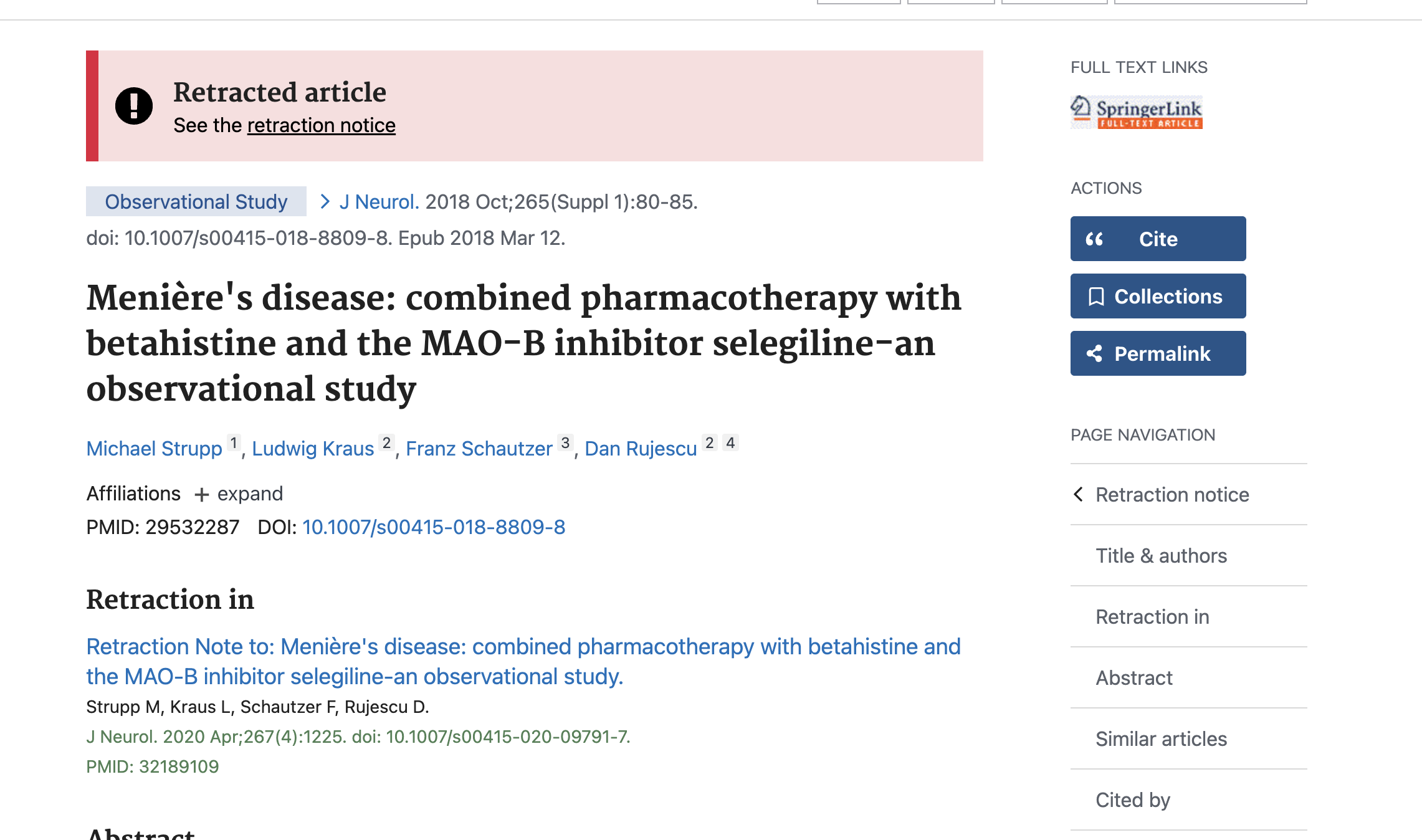
Retractions in scientific literature do not necessarily mean a medication is ineffective or unsafe — they reflect issues with that specific study’s data, methodology, or integrity. However, they do affect the overall quality of evidence available. This is an evolving situation in the field of vestibular research, and it reinforces why clinical decisions about betahistine should always be made by a qualified physician based on the totality of available evidence, and not based on any single study.
The Problem of Self-Medication and Misdiagnosis
I need to address something I see daily at my clinic in Hardoi: patients buying betahistine without proper diagnosis and without ever seeing an ENT specialist.
Here’s what happens: A patient feels dizzy. They read about vertigo online or hear from a friend. They go to a general pharmacy, buy betahistine, and take it for weeks or months without knowing what type of vertigo they actually have. Sometimes they get lucky and it works. But often, they waste time, money, and their actual condition goes undiagnosed and untreated.
I had a patient who had been taking betahistine for eight months because his head felt “weird” when he turned in bed. It never helped. When I examined him properly with the Dix-Hallpike maneuver, I immediately identified BPPV. One five-minute treatment session, and he was better. He’d wasted eight months and hundreds of rupees on the wrong medicine.
My message to patients reading this: Don’t self-treat with betahistine. Get a proper diagnosis first. See an ENT specialist or at least a doctor who can properly examine your balance system. Different types of dizziness need different treatments. Taking the wrong medicine only delays the right treatment.
Does Betahistine Work for “Chakkar”? The Honest Answer
This is probably the most common question I get from patients: “Doctor, will betahistine fix my chakkar?”
My answer: “It depends on what kind of chakkar you have.”
- Room spinning, attacks lasting hours, hearing loss, ringing in ear — That’s likely Meniere’s. Betahistine will probably help significantly.
- Dizziness when you turn your head in bed, sudden head movements trigger spinning, no hearing loss — That’s likely BPPV. Betahistine won’t help. You need physical maneuvers, not medicine.
- Sudden onset spinning after a viral infection — That’s likely vestibular neuritis. Corticosteroids help acutely; betahistine helps with recovery — a combination approach.
- Vague dizziness, lightheadedness, associated with stress or anxiety, no true spinning — That might not be vestibular “chakkar” at all. Betahistine probably won’t help. See your doctor to explore other causes.
“Chakkar” is a symptom, not a diagnosis. Without knowing what’s causing your chakkar, I can’t promise any single medicine will work.
Real Patient Stories: When Betahistine Helped and When It Didn’t
Success Story: A Patient with Meniere’s Disease
One of my patients came with a six-month history of terrible vertigo attacks. She’d have two or three episodes per month where the room would spin violently, she’d vomit, and couldn’t work for days. Her hearing was declining in one ear, and she had constant ringing (tinnitus). I diagnosed Meniere’s disease based on her symptoms, videonystagmography (VNG), and audiometry. I prescribed betahistine as part of her treatment plan, advised dietary sodium restriction, and told her to expect improvement gradually.
At follow-up after several weeks, she reported only one mild episode. After a few months, she was having mild symptoms far less frequently. She continued the medicine long-term and has been largely stable. Her quality of life has improved dramatically.
Failure Story: A Patient with Undiagnosed BPPV
Another patient came to me complaining that he’d been dizzy for three months. Whenever he turned over in bed at night, the room spun, but it lasted only 20–30 seconds. He’d already been on betahistine for six weeks with no improvement. I immediately suspected BPPV from his description. I performed the Dix-Hallpike test, and sure enough: classic BPPV. I did the Epley maneuver, and within a few minutes, he felt better. He was completely fine within a week.
He asked me: “Doctor, I was on betahistine for six weeks. Why didn’t it work?” Because his problem wasn’t inner ear fluid pressure — it was physics: tiny crystals in the wrong part of the inner ear. The cure wasn’t a medicine; it was a five-minute maneuver. He’d wasted six weeks and money on an inappropriate medicine.
Partial Success: A Patient with Vestibular Migraine
A younger patient had a history of migraines with aura, and over the past year her migraines were increasingly accompanied by severe dizziness and balance problems. She’d been prescribed betahistine and it helped a bit, but she was still getting episodes frequently. I recognized this as vestibular migraine and added a preventive migraine medication to her regimen. The combination worked much better, and her episodes became far less frequent. This illustrates that betahistine is sometimes part of the solution — but not always the complete solution.
How Long Before Betahistine Works? Realistic Timeline
Patients always ask, “Doctor, how long will it take to feel better?” Let me give you realistic timelines:
- Week 1–2: Most patients notice nothing. Some get minor side effects like mild nausea. The medicine is working at the cellular level — improving blood flow to your inner ear — but you won’t “feel” it yet. Don’t get discouraged.
- Week 3–4: Some patients start noticing a reduction in symptoms. Episodes might be less severe or less frequent. Others still notice nothing — this is normal variation.
- Week 6–8: This is when I expect to see real improvement if the medicine is going to work. If you notice nothing by this point, betahistine probably isn’t the right medicine for your condition, and further evaluation is needed.
- Week 12+: Maximum benefit is usually reached around 8–12 weeks. After that, improvement tends to stabilize.
Give it time — but also set expectations. If there’s no improvement after the appropriate trial period, see your doctor and reassess.
Betahistine and Pregnancy: Is It Safe?
Several patients have asked me if betahistine is safe during pregnancy. The short answer: betahistine is generally considered to have acceptable safety data, but you should discuss it with your obstetrician and ENT doctor together. Like all medicines during pregnancy, it should be used only if the benefit clearly outweighs the risk. Please seek professional guidance for this.
My Clinical Bottom Line on Betahistine
After many years of prescribing betahistine in my ENT practice, here’s my honest, bottom-line assessment:
- Betahistine is an excellent, well-tolerated medicine for Meniere’s disease and certain vestibular disorders. If you have true Meniere’s disease, it can significantly improve quality of life for most patients.
- Betahistine is not a cure-all for “chakkar.” It works for specific conditions. Without proper diagnosis, taking betahistine is like throwing darts blindfolded — you might hit the target, or you might just waste money and time.
- Don’t self-treat with betahistine without seeing a doctor. Get a proper diagnosis first. Self-medication delays appropriate care.
- If betahistine is prescribed for you, take it properly: with food, regularly, and for the duration your doctor recommends. Don’t expect instant results.
- If betahistine isn’t working after the appropriate trial period, something is wrong — either it’s not the right condition, or the diagnosis needs revisiting. See your doctor and reassess.
- Be aware that some research on betahistine has been retracted (as discussed above). The evidence base is still evolving, and clinical decisions should be made in consultation with your doctor.
Frequently Asked Questions About Betahistine
Can I buy betahistine without a doctor’s prescription in India?
Technically, betahistine may be available at pharmacies, but just because you can obtain it doesn’t mean you should take it without medical guidance. I strongly advise against self-treatment. Get a proper diagnosis first so you know whether betahistine is appropriate for your condition.
Why didn’t betahistine work for my chakkar?
Most likely, your “chakkar” is not a condition that betahistine treats effectively. BPPV doesn’t respond to betahistine — it needs physical maneuvers. Anxiety-related dizziness needs a different approach entirely. Without knowing what type of vertigo you have, I can’t explain why the medicine didn’t work. See an ENT specialist for a proper diagnosis.
Is betahistine safe for long-term use?
Long-term safety data generally supports chronic use of betahistine under medical supervision. Patients have taken it for years without major issues. However, periodic check-ups with your doctor are still important to assess ongoing need and monitor for any changes.
Can betahistine cure Meniere’s disease?
No. Betahistine controls symptoms and helps prevent attacks but doesn’t eliminate the underlying condition. Most Meniere’s patients benefit from staying on betahistine long-term as part of their management plan. Think of it like blood pressure medicine — it controls the condition but needs to be continued for sustained benefit.
Can I take betahistine with my other medicines?
Generally, betahistine doesn’t interact significantly with most common medicines. However, always inform your doctor about all medicines you take — including over-the-counter drugs, supplements, and herbal remedies. Your doctor needs the complete picture to make safe prescribing decisions.
Key Takeaways: What You Should Remember
- Betahistine works best for Meniere’s disease and certain vestibular disorders — not all dizziness
- It must be taken regularly and consistently as prescribed by your doctor, with food
- Don’t expect instant results — it works gradually over weeks to months
- Get a proper diagnosis before starting betahistine — different dizzinesses need different treatments
- BPPV needs physical maneuvers, not betahistine; vestibular neuritis needs steroids acutely
- Side effects are usually mild (nausea, headache) and manageable, especially when taken with food
- Long-term use is safe if medically appropriate and under medical supervision
- Be aware that some research on betahistine, including papers by Strupp et al., has been retracted — always discuss the latest evidence with your doctor
- Never self-medicate with betahistine — see a qualified physician first
Need Help With Vertigo? Prime ENT Center, Hardoi
If you’re dealing with persistent dizziness, vertigo, or balance problems, you need proper diagnosis and treatment. Don’t guess. Don’t self-treat with betahistine or any other medicine without professional evaluation.
At Prime ENT Center in Hardoi, I offer comprehensive vertigo evaluation, including:
- Detailed history and physical examination
- Specialized balance testing (Dix-Hallpike, Romberg, Fukuda)
- Videonystagmography (VNG) for quantitative balance assessment
- Audiometry if hearing loss is suspected
- Treatment of BPPV with proper maneuvers (Epley, Semont, Barbecue roll)
- Prescription of appropriate medicines based on diagnosis
- Long-term management and follow-up
I also offer consultations for patients from neighboring areas in Uttar Pradesh, including Lucknow, Kanpur, Bareilly, and beyond.
Contact Prime ENT Center, Hardoi
Phone: 7393062200
I’m Dr. Prateek Porwal, MBBS, DNB ENT, CAMVD | ENT & Vertigo Specialist. I look forward to helping you get to the bottom of your vertigo and get you back to feeling normal.
Medical Disclaimer: This article is for educational purposes only and does not constitute medical advice, diagnosis or prescribing guidance. Consult Dr. Prateek Porwal at Prime ENT Center, Hardoi for personalised treatment.
References
- Lacour M, van de Heyning PH, Novotny M, Tighilet B. a vasodilator medication in the treatment of Ménière’s disease. Neuropsychiatric Disease and Treatment. 2007;3(4):429–440.